The Labour Market Risk Nobody in Housing Is Talking About
Australia's housing debate centres on interest rates, supply, migration and tax. There's a fourth variable that rarely appears: whether the labour market that underpins mortgage demand will look anything like it does today within a decade. Every mortgage is a bet on future income — and AI is quietly reshaping the professional class those incomes depend on.

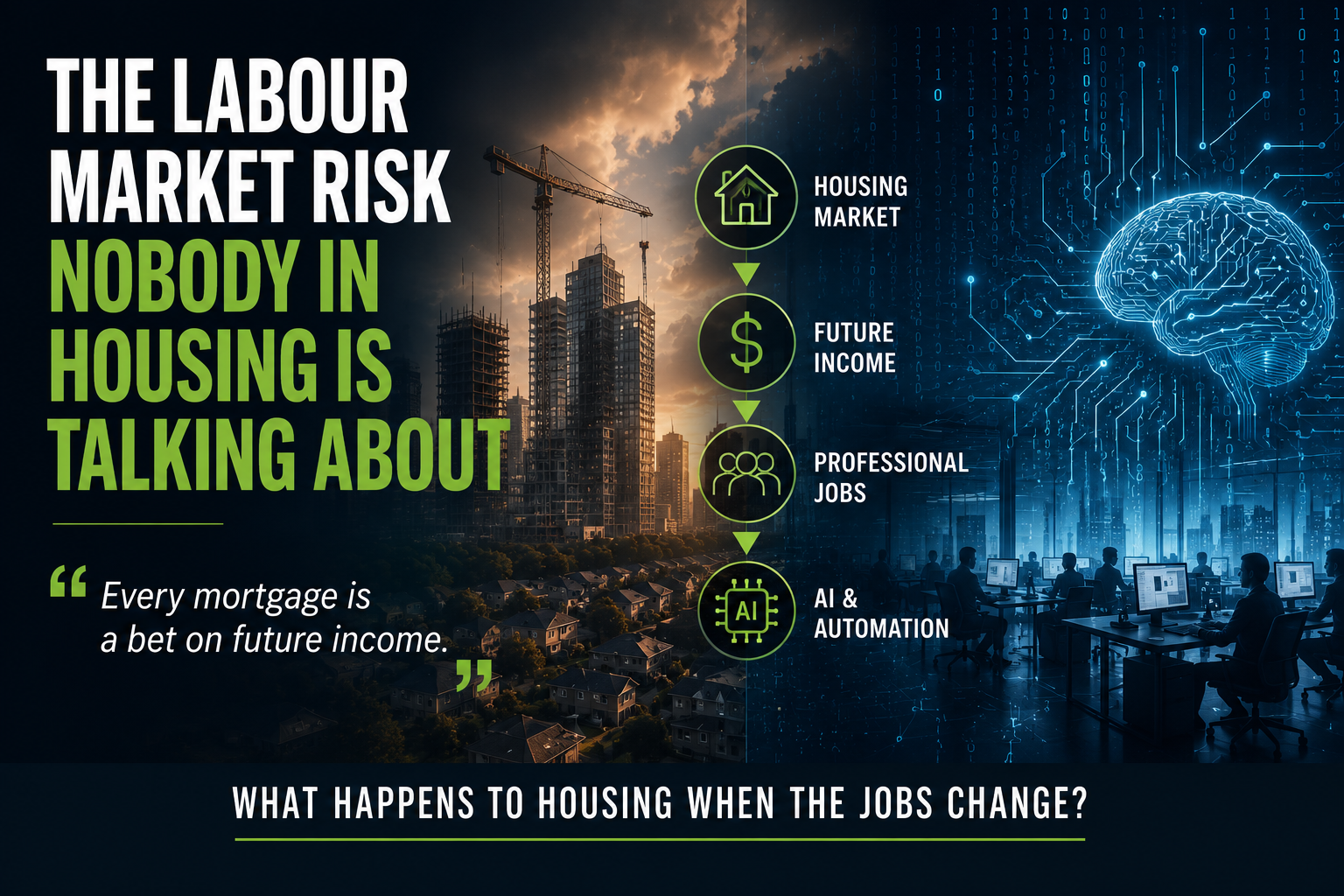
Australia's housing debate has centred on interest rates, supply, migration, and tax policy. There is a fourth variable that rarely appears in that conversation: whether the labour market that underpins mortgage demand will look anything like it does today within a decade.
Every mortgage is, at its core, a bet on future income. A borrower takes on a 30-year obligation because they believe they will continue to earn. A bank approves the loan for the same reason. A property investor enters the market expecting that rental demand will hold because tenants will continue to have jobs, incomes, and the capacity to pay.
That assumption has held for generations. It may not hold for the next one.
Artificial intelligence is reshaping the architecture of white-collar work at a speed that our housing commentary has not yet absorbed. This is not a forecast about robots displacing factory workers. It is a more immediate observation: that AI is already performing meaningful portions of the cognitive, analytical, and administrative work that forms the career backbone of Australia's professional class. The people with the incomes, the borrowing capacity, and the confidence to sustain long-term housing commitments are precisely the cohort whose work is most exposed.
What AI is actually changing
Across professional services, finance, law, engineering, consulting, and project management, AI tools are already assisting with report preparation, contract review, financial modelling, research synthesis, cost analysis, and decision support. Today, these tools make individual professionals more productive. That is broadly positive.
But productivity gains at the individual level translate, over time, into organisational restructuring. If one person can now do the work of three, the business case for hiring three eventually weakens. Graduate pipelines thin. Middle management layers compress. Career progression pathways that previous generations could rely on become less predictable.
The generational assumption, that each cohort will earn more than the one before it, is worth scrutinising carefully. It has been a reliable driver of housing demand. Its disruption would not need to be dramatic to have material consequences for borrowing capacity, consumer confidence, and investment appetite.
The policy conversation we are not having
Australia continues to measure economic progress through population growth, housing approvals, migration intake, and university enrolment. These are legitimate metrics. But they tell us very little about the future earning capacity of the people we expect to fill those dwellings and service those mortgages.
We are encouraging younger Australians to pursue professional degrees and home ownership as the path to financial security, while the professions those degrees lead into are among the most exposed to AI-driven structural change. That is not an argument against education or home ownership. It is an argument for being honest about the conditions under which those pathways are being offered.
Housing policy has traditionally focused on the supply side: planning reform, infrastructure investment, density targets, and construction capacity. These are necessary interventions. But supply-side solutions assume the demand side is stable.
The demand side is not independent of labour market structure.
A specific challenge for professional bodies
There is a dimension to this that professional bodies are positioned to address, and largely have not.
In the built environment professions, as in accounting, law, and engineering, expertise has historically been developed through structured repetition. Junior practitioners learned by doing foundational technical work. That work generated not just output, but judgment. Over years, the accumulation of judgment became the basis for advancement, leadership, and professional authority.
If AI increasingly performs that foundational layer of work, the question is not simply whether jobs survive. It is whether the pipeline that produces senior practitioners remains intact. The profession that relies on AI to do what graduates once did may find, a decade from now, that it has efficient output but a depleted leadership base.
This is where professional bodies have a genuine responsibility, not just to advocate for their current members, but to redesign the development frameworks through which future leaders are created. The competency standards, the supervised training requirements, the continuing professional development expectations all need to be examined with this structural shift in mind.
The future practitioner will need to demonstrate judgment that AI cannot replicate: commercial instinct, strategic advice, professional accountability, and the capacity to operate in complex, high-stakes environments where the answer is not computable. Those capabilities need to be deliberately cultivated. They will not emerge naturally from a training environment in which AI has absorbed the technical scaffolding.
What action looks like
Professional associations should be leading the conversation at the intersection of AI, workforce structure, and the future earning capacity of their members. Not as a defensive exercise, but as a forward-looking contribution to industry and government policy on workforce planning.
That means engaging with education institutions on curriculum design for an AI-augmented profession. It means advocating for supervised training standards that cannot be quietly hollowed out by efficiency pressures. It means contributing substantively to housing and economic policy discussions with data about professional workforce trends, not just project volumes.
And it means being willing to say clearly, in public forums and in submissions to government, that the stability of Australia's housing market is not only a function of interest rates and land supply. It is a function of the sustained earning power of the professional and managerial workforce. That workforce is undergoing structural change. The pace of that change is not yet reflected in how we talk about housing risk.
Innovation, historically, has created more than it has displaced. There is every reason to believe AI will ultimately expand economic opportunity and help address challenges, including housing supply, that have resisted conventional solutions. The concern is not the destination. It is whether institutions, professional bodies, universities, and governments are moving at the speed required to shape the transition rather than simply absorb it.
The biggest threat to housing may not be the ones dominating the current debate. It may be a quiet structural shift in the labour market that nobody in the housing conversation has yet made their problem to solve. Professional bodies should be the ones to change that.
— Mark
Mark Kilroy — BSc Hons, MRICS, MAIQS, CQS — CEO, Koste Chartered Quantity Surveyors
“Property is bought once. It has to be held every day.”
Sources
Frequently Asked Questions
Why is the labour market a housing risk, not just an employment issue?
A mortgage is a 30-year bet on future income. Borrowers commit, banks approve, and investors buy rental property all on the assumption that incomes — and tenants' capacity to pay rent — will hold. If AI structurally compresses the earning capacity of the professional and managerial workforce, borrowing capacity, consumer confidence and investment appetite all soften at the same time. The disruption doesn't need to be dramatic to have material consequences for housing demand.
How does AI improving individual productivity end up reducing jobs?
In the short term, AI tools make individual professionals more productive, which is broadly positive. But productivity gains at the individual level translate over time into organisational restructuring. If one person can now do the work of three, the business case for hiring three eventually weakens. Graduate pipelines thin, middle-management layers compress, and the career progression pathways previous generations relied on become less predictable.
What is the threat to the 'pipeline' of senior practitioners?
In the built environment, accounting, law and engineering, expertise has historically been developed through structured repetition — junior practitioners learning by doing foundational technical work, which over years builds the judgment that underpins advancement and leadership. If AI increasingly performs that foundational layer, the profession may find a decade from now that it has efficient output but a depleted leadership base, because the training ground that produced senior practitioners has been hollowed out.
What should professional bodies actually do about it?
Professional associations should lead the conversation at the intersection of AI, workforce structure and members' future earning capacity — not defensively, but as a forward-looking contribution to industry and government policy. In practice that means engaging education institutions on curriculum design for an AI-augmented profession, advocating for supervised training standards that can't be quietly hollowed out by efficiency pressures, and contributing to housing and economic policy with data about professional workforce trends, not just project volumes.
Explore further
Related commentary
Frameworks & tools
Republishing
You're welcome to republish this article in full or in part, provided it includes clear attribution to Mark Kilroy and a link back to the original at markkilroy.com.au.
For media enquiries, syndication requests, or to discuss republishing in print or digital publications, please get in touch.
The Kilroy Brief
One practical briefing on the policy, tax, cost and cash-flow forces shaping Australian property ownership. For owners, investors and advisers who want the mechanics behind the headlines. Sent when there is something worth saying, not to fill a schedule.