Australia Lets Property Investors Depreciate Their Buildings. Why Don't Other Countries?
Mark Kilroy compares building depreciation in Australia and other countries, examining how tax policy, construction costs and development feasibility affect investment in new housing.


Having worked in quantity surveying and property in both the United Kingdom and Australia, one thing that has always interested me is how differently governments treat the same investment for tax purposes.
Take a residential investment property.
In Australia, investors can generally claim depreciation on eligible building construction costs over 40 years.
In the United States, residential rental buildings are generally depreciated over 27.5 years. Canada also allows depreciation on rental buildings, although it has restrictions on how those deductions can be used.
But in the United Kingdom, where I began my career, residential rental buildings generally do not qualify for an annual building depreciation allowance.
New Zealand takes a similar approach.
The buildings still deteriorate. They still require maintenance, repairs and eventually major capital expenditure.
Yet the tax treatment can be completely different.
It raises an interesting question. Is tax depreciation an incentive for property investors, or simply recognition that a building has a limited economic life?
And with Australia's housing shortage, should we be looking more closely at how these rules influence investment in new housing?
How does Australia compare with other countries?
The international differences are quite substantial.
| Country | Residential rental buildings | Commercial buildings |
|---|---|---|
| Australia | Yes. Generally 2.5% annually over 40 years | Yes. Generally 2.5%, with 4% for certain qualifying buildings |
| United States | Yes. Generally 27.5 years | Yes. Generally 39 years |
| Canada | Yes. Commonly 4% diminishing balance | Yes. Commonly 4% diminishing balance |
| United Kingdom | Generally no | Yes. 3% for qualifying non-residential structures |
| New Zealand | Generally no for long-life buildings | Generally no for long-life buildings from the 2024–25 income year |
| Singapore | Generally no | No general building depreciation allowance; limited historical industrial building relief |
Source: ATO, IRS, Canada Revenue Agency, HMRC, Inland Revenue New Zealand and IRAS. Rates are indicative and depend on eligibility. This comparison excludes separate plant, equipment and fit-out allowances.
Australia is certainly not alone in recognising depreciation on residential buildings.
The United States and Canada do the same, although their systems operate differently.
In Canada, for example, capital cost allowances cannot be used to create or increase a rental loss.
The UK generally excludes residential rental buildings from its Structures and Buildings Allowance, while qualifying commercial buildings can receive a 3% annual deduction.
New Zealand is particularly interesting.
It allowed depreciation on most buildings until 2011, subsequently restored depreciation on qualifying commercial buildings for several years, and then returned the rate to zero from the 2024–25 income year.
Think about that for a moment.
The building hasn't changed. Its construction costs haven't changed. It still deteriorates and requires ongoing investment.
What has changed is the government's decision about whether the cost of that building should be recognised through annual tax deductions.
And that is what makes the international comparison worth discussing.
A building is not the same as the land
One of the biggest misconceptions I encounter is that tax depreciation is calculated on the market value of a property.
It isn't.
In Australia, Division 43 generally allows investors to claim 2.5% of eligible building construction expenditure each year, over a maximum period of 40 years.
A house purchased for $1 million does not automatically produce a $25,000 annual capital works deduction.
If the qualifying construction costs were $400,000, the annual deduction could be $10,000, assuming the property qualifies and the full annual entitlement remains available.
That is a deduction against taxable income, not a $10,000 payment from the government. Capital works deductions can also affect the property's capital gains tax cost base.
As a quantity surveyor, I see the distinction between land and improvements every day.
Land can increase substantially in value while the building sitting on it deteriorates.
Roofs eventually need replacing. Air-conditioning systems fail. Bathrooms and kitchens become outdated. Building services and equipment have limited useful lives.
We assess these costs across residential properties, commercial buildings, hotels, industrial facilities and major government assets.
The underlying principle is the same.
Buildings require capital investment to construct, maintain and eventually replace.
Yet countries have very different views about how those costs should be treated for taxation purposes.
Australia needs 1.2 million new homes. But who is going to pay for them?
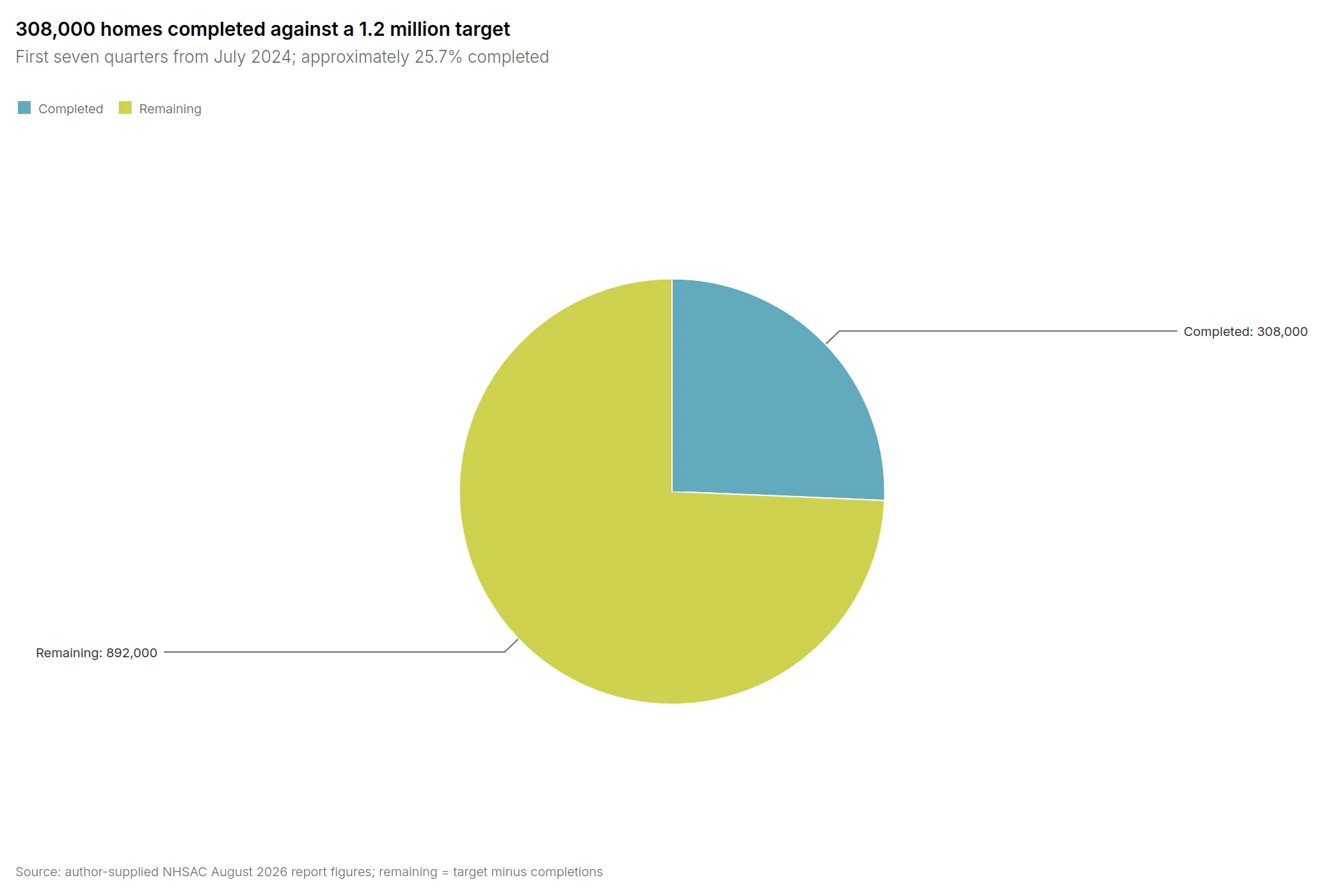
Australia has committed to delivering 1.2 million new homes over five years from July 2024.
According to the National Housing Supply and Affordability Council's August 2026 report, approximately 308,000 homes had been completed during the first seven quarters.
That represents approximately 25.7% of the national target.
It leaves around 892,000 homes still to be completed against the target.
The Council estimates that Australia will not reach 1.2 million homes until the December quarter of 2030.
That is well beyond the original five-year target period.
And there is another major problem.
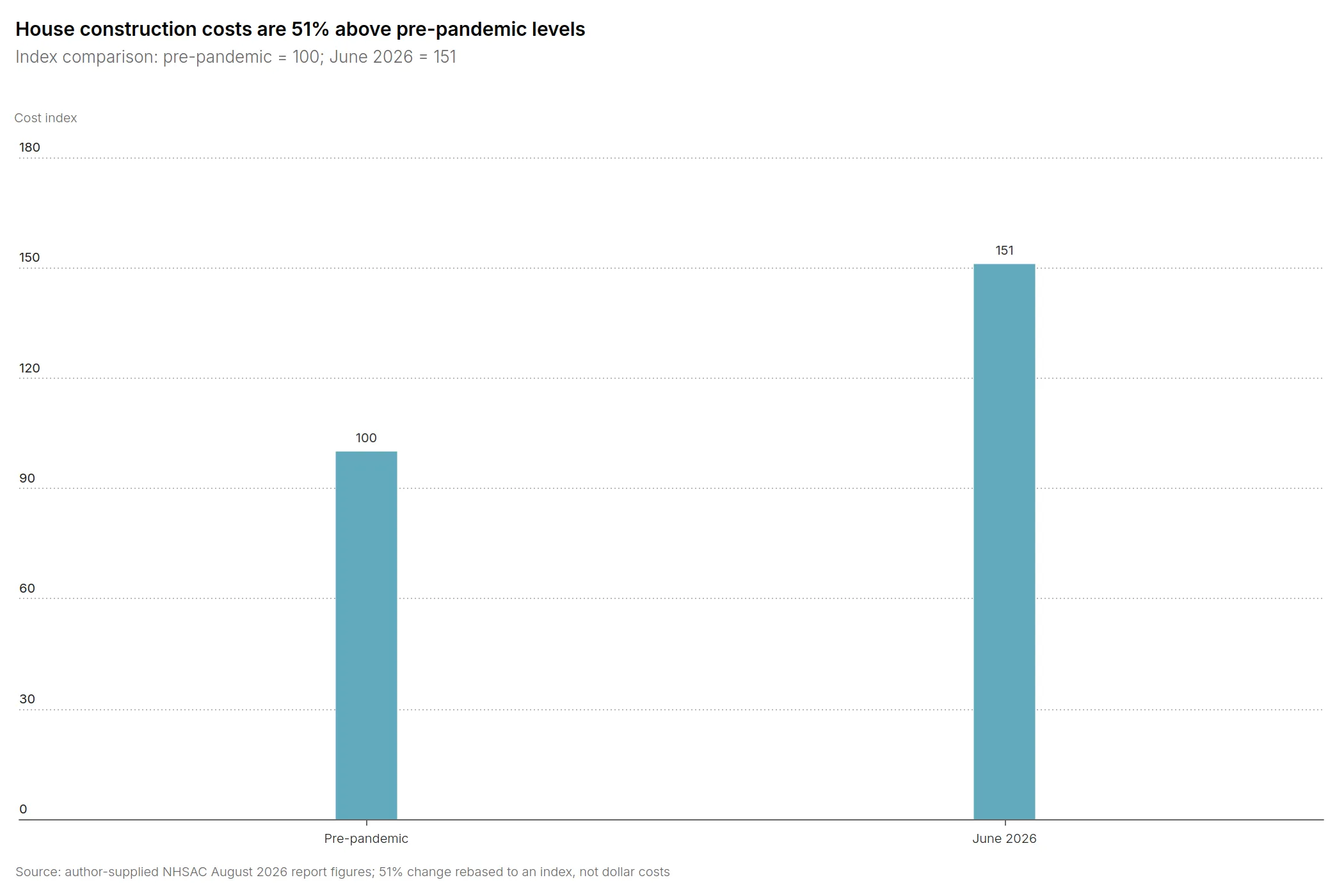
The same report found that house construction costs were approximately 51% higher than before the COVID-19 pandemic.
Think about what that means for developers and anyone looking to build.
A project that may have been financially viable several years ago can look very different today.
Construction costs, financing, labour availability, infrastructure charges, approval delays and development contributions all influence whether a project proceeds.
Through my work in quantity surveying, I see how important construction feasibility is to investment decisions.
Developers cannot simply build because there is a government housing target.
Someone needs to fund the project, someone needs to carry the financial risk, and ultimately the development needs to make commercial sense.
That is where tax policy becomes relevant.
Not because depreciation alone will make an unviable project viable, but because the overall tax treatment influences the returns investors expect from putting capital into property.
Not all property investment creates new housing
There is an important distinction that often gets overlooked in the debate about property investors.
An investor purchasing an existing house from another investor does not directly increase Australia's housing supply.
The property changes hands, but there is still the same number of homes.
That transaction can help provide rental accommodation, particularly when a property moves from owner-occupation to the rental market, but it does not create an additional dwelling.
Now consider a developer proposing to build 100 new apartments.
The project may require a certain number of presales before a bank will provide construction finance.
Investors purchasing those apartments off the plan can help the development reach its financing requirements.
If the project proceeds, those investments can contribute to additional housing supply.
Those are two very different economic outcomes.
And I think that distinction deserves far more attention when we discuss how investment property should be taxed.
The 2027 tax changes make this more important
Australia's 2026 Federal Budget announced major changes to negative gearing and capital gains tax.
From 1 July 2027, negative gearing against unrelated income will generally be restricted to eligible new residential builds.
Investors who purchased established residential properties after 7:30 pm AEST on 12 May 2026 will generally no longer be able to offset rental losses against wages and other non-residential income from that date.
Those losses can still be used against qualifying residential property income, including certain capital gains, or carried forward under the announced arrangements.
Properties held before Budget night are grandfathered for the negative gearing changes.
The government is also changing capital gains tax arrangements from 1 July 2027, replacing the existing 50% discount with an inflation-based approach and a minimum tax on gains, subject to the detailed rules and exceptions.
The stated objective is to direct investment towards new housing rather than encourage greater competition for established properties.
There is an economic argument for that distinction.
But we also need to recognise that private investors provide much of Australia's rental accommodation, and changes in tax treatment can influence investment decisions.
The key question is what happens to the capital.
Does it move towards new residential construction?
Does it shift into commercial property, shares or other investments?
Or do financing and construction costs remain such significant obstacles that the tax changes have little impact on actual housing delivery?
These are the questions I think matter.
It is also important to distinguish depreciation from negative gearing.
Division 43 recognises qualifying construction expenditure. Negative gearing concerns the treatment of an overall investment loss.
They interact, but they are not the same thing.
Other countries are using depreciation to encourage new rental housing
Canada has proposed an accelerated 10% capital cost allowance for eligible new purpose-built rental housing, compared with the conventional 4% rate that applies to many rental buildings.
Australia has also introduced enhanced deductions for eligible build-to-rent developments.
Qualifying developments can receive a 4% annual capital works deduction, compared with the usual 2.5%.
This is an interesting policy decision.
Rather than treating every type of property investment the same way, governments can use the tax system to encourage particular forms of construction.
In this case, the objective is to attract investment into new rental accommodation.
But there is an important qualification.
Increasing a depreciation rate does not automatically produce more homes.
Land still needs to be available. Planning approval still needs to be obtained. Construction finance must be secured, and developers still need to manage the cost of building.
The National Housing Supply and Affordability Council itself considers the recent Australian tax policy changes likely to have a modest impact on housing supply.
That is worth acknowledging.
It suggests we need to look at the entire development environment rather than assuming changes to tax deductions will solve the problem.
Have we become too focused on taxing investors?
I think much of the discussion about property investment focuses on what investors can claim rather than what their investment actually delivers.
Those are not necessarily the same thing.
A developer committing capital to construct 100 new apartments is contributing something different from an investor simply purchasing an established property.
Both can play a role in the housing market, but the economic outcomes are different.
I would like to see more discussion about how tax policy encourages productive investment.
If we need more housing, what will encourage more projects to proceed?
If construction costs have increased by 51% since before the pandemic, what are we doing to improve construction productivity and reduce unnecessary costs?
If planning approvals and infrastructure delays are holding back supply, how much difference will changes to investment tax deductions actually make?
The Productivity Commission's July 2026 interim report identified land-use restrictions and infrastructure coordination as major areas where reform could improve housing supply.
That reinforces the need to look beyond taxation.
A depreciation deduction cannot overcome a development approval that takes years.
It cannot compensate for a shortage of skilled trades, or land that cannot be developed because essential infrastructure is missing.
But equally, discouraging private investment without understanding where that capital will go may not produce the housing outcomes policymakers expect.
What should Australia be encouraging?
I don't think every tax concession for property investment should automatically be defended.
Equally, I don't think every deduction should be characterised as a government handout.
There is a difference between recognising the legitimate cost of constructing a building and designing additional tax incentives to influence investor behaviour.
Tax depreciation can serve both purposes, depending on the rules.
As a Chartered Quantity Surveyor, I think it is important that the cost of buildings and their components is understood properly.
Australia's Division 43 system recognises qualifying construction expenditure over time.
That is an established principle.
The bigger policy question is whether additional incentives should be more closely connected to the creation of new housing, and whether those incentives are sufficient to overcome the practical obstacles to development.
For me, those questions deserve more attention than simply debating whether property investors should receive deductions.
We need more homes, not just more tax arguments
Having worked across different property markets, I find it fascinating that governments can reach such different conclusions about the tax treatment of essentially the same physical asset.
A residential rental building in Australia can qualify for capital works deductions.
A comparable building in the United States can also qualify, but under a different depreciation system.
In the UK or New Zealand, the same type of building generally does not qualify for annual building depreciation.
The building still ages.
The construction costs still have to be funded.
And somebody still has to pay for its long-term maintenance and eventual replacement.
Meanwhile, Australia faces a housing target of 1.2 million new homes, construction costs substantially above pre-pandemic levels and ongoing challenges around development feasibility.
I think we should be asking whether the overall tax and regulatory environment is encouraging the investment needed to deliver more housing.
Not every property investment adds to supply.
Not every tax incentive will result in another home being built.
And depreciation deductions alone will certainly not solve Australia's housing shortage.
But if we genuinely want the private sector to help deliver more housing, shouldn't we be examining how tax policy, construction costs and development feasibility work together, rather than debating each in isolation?
That is a conversation worth having.
This article reflects information available as at 9 November 2026 and is intended as general industry commentary, not individual tax or investment advice.
“Property is bought once. It has to be held every day.”
What you can do
Practical HOLD Tips related to this commentary.
Are you claiming your share of common property depreciation?
Owners in strata properties are entitled to a depreciation share of common property assets — lifts, shared roof structures, pool equipment — but it's sometimes missed.
Depreciation scrapping: the deduction most owners miss during a renovation
When assets are removed during a renovation, there is often remaining depreciable value that can be claimed — but only if it's identified before demolition, not after.
What records you need before you sell
The records that reduce your capital gains tax bill are the ones that are easiest to lose, and the hardest to reconstruct after the fact.
Explore further
Related commentary
Frameworks & tools
Republishing
You're welcome to republish this article in full or in part, provided it includes clear attribution to Mark Kilroy and a link back to the original at markkilroy.com.au.
For media enquiries, syndication requests, or to discuss republishing in print or digital publications, please get in touch.
The Kilroy Brief
One practical briefing on the policy, tax, cost and cash-flow forces shaping Australian property ownership. For owners, investors and advisers who want the mechanics behind the headlines. Sent when there is something worth saying, not to fill a schedule.