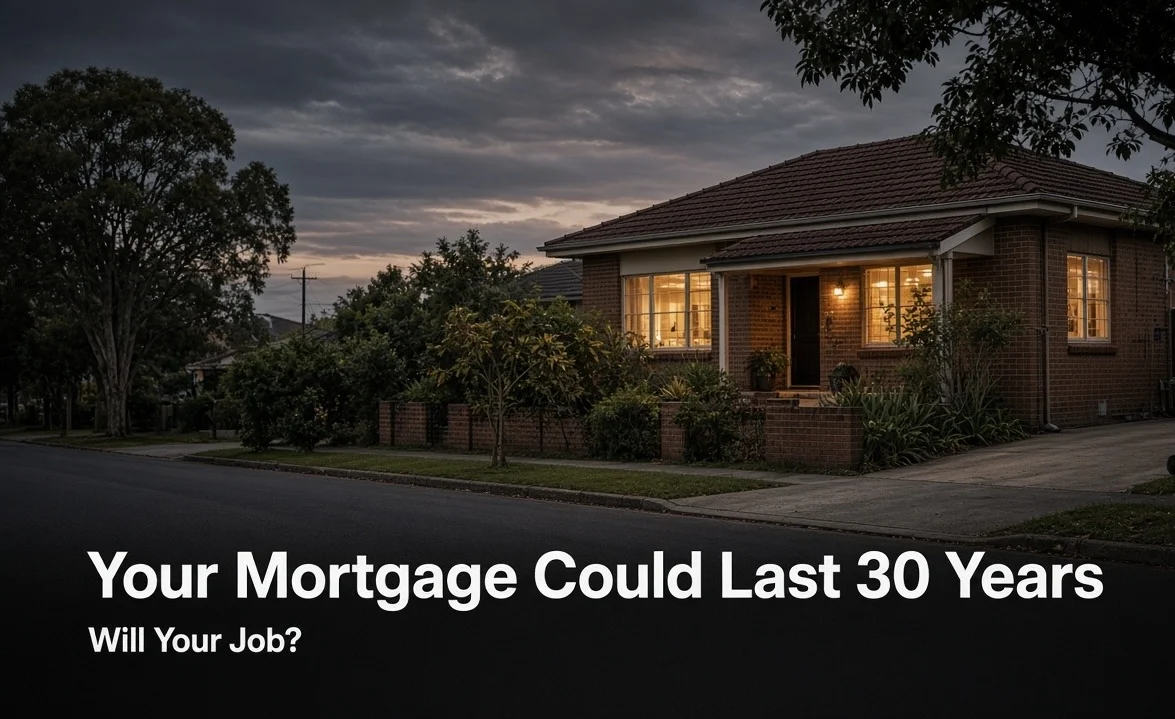
Your Mortgage Could Last 30 Years. Will Your Job?
Mark Kilroy examines how AI-related changes to work could affect income durability, mortgage resilience and the ability to hold property. The argument is not against buying, but for giving long-term ownership pressures as much attention as borrowing capacity at purchase.

Most of the AI discussion sits at one of two extremes. Either it will change the world for the better, or it will destroy millions of jobs and remake the economy.
For property owners, there is a more practical question: what happens to housing if the income servicing today’s mortgages becomes less reliable over the life of those loans?
We spend a lot of time on whether people can afford to buy: deposits, borrowing capacity, interest rates and how much the bank will lend. Getting approved is only a snapshot. A bank looks at income today, expenses, debt and the buffer it applies to repayments. If the numbers work, the loan is approved. That loan might then run for 30 years, and in some cases longer. Your income probably will not look the same for those 30 years.
That has always been true to some extent. AI potentially accelerates it. Some jobs may disappear. Others will change. Some people will earn more because they use AI well. Others may find work less secure, more contract-based or simply lower paid than before.
That does not mean millions of Australians lose their jobs next year. It does mean the income used to approve a mortgage today may not be as predictable as people assume across the full life of that loan. That is where the property conversation needs to change.
For a first-home buyer, the risk is not only whether they can afford to buy. It is whether they can continue to hold. For an investor, it is the same issue from another angle. If household income falls, work becomes less secure or expenses keep rising, the gap between income and the cost of holding an asset widens. That is when people start making decisions under pressure: selling at the wrong time, using credit for ordinary expenses, cutting buffers, delaying maintenance, or relying on future capital growth to fix a current cash-flow problem.
This is why I keep coming back to HOLD. Buying the property is not the strategy. Holding it through changes in rates, tax, employment, family circumstances and the economy is the strategy. AI could simply become another of those pressures.
There is a second issue. Australia rightly talks about housing supply: more homes, better approvals, more construction capacity and better delivery. Supply is only one side of the equation. People still need the income and borrowing capacity to pay for that housing. If AI changes the earning profile of large parts of the workforce, the housing conversation is not only about how many homes we can build. It is also about who can continue to afford them.
I am all for first-home buyers. Young people should be able to own. I am also all for investors. They are a large part of how Australia actually supplies rental housing. Too often, the policy debate treats those as opposites.
We encourage young Australians onto the ladder through deposit support and, in some cases, longer loans. In my view, that focus on entry has not been matched by enough attention to the costs and pressures of holding, including for investors. When an investor-owned property moves into owner-occupation, a rental dwelling can leave the market, but the buyer may also leave a rental home, reducing rental demand. The overall effect depends on who buys, who moves and whether new supply keeps pace.
Helping someone buy without enough room to withstand an income shock is not necessarily a win for young people. It is nervousness with a settlement date.
Government did not invent AI. But policy still shapes the costs and conditions under which investors hold. If income durability is also about to become more uncertain, we need owners of all kinds who can hold, not a market that celebrates purchase while making long-term ownership harder.
I also think banks will eventually look harder at income durability. Not because they will suddenly stop lending to white-collar workers, but because a stable salary in a role being reshaped quickly may not carry the certainty it once did. That could mean more focus on buffers, household income diversity, employment stability and how exposed a particular income stream is to change. That is my expectation, not a new lending rule announced by anyone.
Again, this is not a reason not to buy property. It is a reason to stop treating settlement as the finish line.
For me, HOLD means thinking further ahead.
Hold means avoiding decisions forced by a temporary income shock.
Optimise means continually reviewing costs, rent, structure and after-tax cash flow.
Leverage means using equity carefully, not assuming equity can replace income.
Defend means having buffers and making decisions before pressure builds.
AI may create enormous productivity and opportunity. It may also create a period where income becomes less predictable for some households. The bigger question for property owners is therefore not whether AI takes your job. It is this:
If the income that bought your property changes, what keeps the property held?
That is the question more owners should be asking now.
“Property is bought once. It has to be held every day.”
Explore further
Related commentary
Frameworks & tools
Republishing
You're welcome to republish this article in full or in part, provided it includes clear attribution to Mark Kilroy and a link back to the original at markkilroy.com.au.
For media enquiries, syndication requests, or to discuss republishing in print or digital publications, please get in touch.
The Kilroy Brief
One practical briefing on the policy, tax, cost and cash-flow forces shaping Australian property ownership. For owners, investors and advisers who want the mechanics behind the headlines. Sent when there is something worth saying, not to fill a schedule.