Do We Always Need More Workers?
Mark Kilroy considers what AI, robotics and automation could mean for Australian productivity, workforce planning, migration, housing and long-term prosperity.

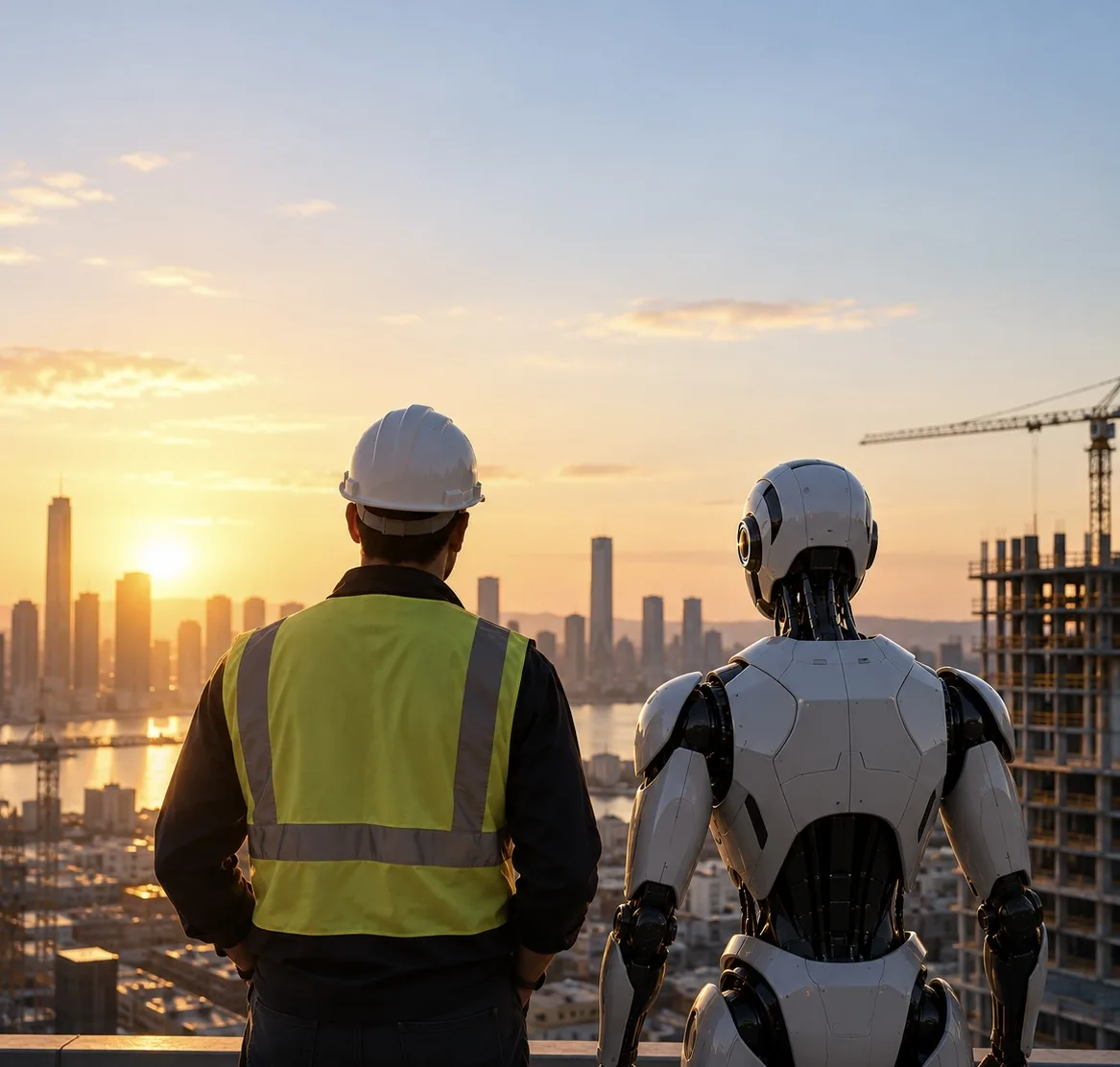
I have been thinking quite a bit about Australia’s productivity problem, particularly as we build more technology and AI into our own business. For most of my career, growing a business was fairly straightforward. More clients and more work generally meant employing more people. I am starting to question whether that relationship will be as strong in five or ten years.
We have spent years building our own technology at Koste, including Capal for producing and managing professional reports and more recently Koste.ai, which is becoming our own internal AI assistant and agent. What interests me most isn’t getting AI to write an email or answer a question. It is giving it tasks, allowing it to work through our systems and processes, and then bringing the result back to someone for review.
I can already see how this starts to change the relationship between growth and headcount. That doesn’t mean replacing professional judgement. We operate in an industry where evidence, accuracy and accountability matter. A qualified professional still needs to review important work and take responsibility for the outcome.
For me, the opportunity is to automate more of the work without automating the accountability. I also look at businesses continuing to employ more people to perform technical, administrative and process-driven work, often at relatively junior levels, and wonder how much of that work will eventually be performed differently.
Reading documents, researching, extracting information, checking data, preparing calculations, drafting and administration are exactly the areas where AI is improving quickly. Agents take this further because the technology isn’t simply helping someone with a task. Increasingly, it can participate in completing the task itself.
I still need quantity surveyors. The question is whether we will eventually need the same number of quantity surveyors to produce the same amount of work. There is a big difference. This isn’t limited to professional services either. Look at autonomous mining equipment, automated warehouses, agricultural technology, advanced manufacturing and robotics.
Construction is particularly interesting. Infrastructure Australia has reported that 64 per cent of building and construction businesses it surveyed invested in digitalisation over the previous year, including AI, robotics and automation. At the same time, Australia continues to face major infrastructure workforce shortages.
We need more workers today, while simultaneously investing in technology designed to allow each worker to produce more. Both things can be true. But will they still both be true in 10 or 20 years?
Australia has a productivity problem
This is why I think we need to look at AI and robotics differently. Australia’s labour productivity fell 0.2 per cent over the year to June 2026. The economy grew, but the number of hours worked grew faster than the amount we produced. We cannot rely forever on economic growth coming from adding more people and working more hours. At some point we need to produce more from each hour.
Perhaps AI, agents, automation and robotics are part of the answer. If an accountant can manage more clients, an engineer can analyse more projects, a quantity surveyor can process more work and a construction team can build more homes, that is productivity. It doesn’t necessarily mean those jobs disappear.
It means each person can produce more. That should be a good thing for Australia.
So how many workers will we actually need?
This is where I think the population debate gets interesting. Australia’s population reached 27.8 million at the end of 2025. We added another 412,500 people in 12 months, with net overseas migration accounting for 301,000 of that increase. Migration is expected to moderate, but Australia is still planning for millions more people over the coming decades.
I am not arguing that Australia should stop migration. We clearly need skilled migration and have benefited enormously from it. We need doctors, nurses, engineers, construction workers, entrepreneurs and people with skills we simply don’t have enough of. But Dick Smith has recently been asking whether Australia needs a proper national population plan. I think that is a reasonable question, even if people disagree with the population or migration levels he advocates.
I would add another question. What economy are we planning that population for? If AI, agents, robotics and automation significantly increase output per worker over the next 10 or 20 years, surely that has to form part of our assumptions about the workforce Australia will require.
That doesn’t mean assuming mass unemployment. History is full of predictions that technology would eliminate huge numbers of jobs, only for new jobs and industries to emerge. Jobs and Skills Australia’s research currently points towards generative AI augmenting more jobs than simply replacing them.
But jobs don’t have to disappear for the economics to change. If 100 people can eventually produce what previously required 150, or those same 100 people can produce twice as much, the workforce requirement has changed. Multiply that across thousands of Australian businesses and industries and it becomes a much bigger economic question.
Then there is housing
This is where population decisions become very real. Every additional household needs somewhere to live. A growing population also needs roads, hospitals, schools, electricity, water and other infrastructure. Population growth isn’t inherently a housing problem if supply can keep up.
Australia’s problem is that it hasn’t. This can create a strange cycle. We need more workers, so population increases partly to provide those workers. Those additional people need more homes and infrastructure, but we don’t have enough workers to build everything we need, so we need more workers again.
At some point productivity has to become a bigger part of the solution. Construction is a good example. If Australia needs substantially more housing, perhaps the answer isn’t simply substantially more construction workers. Perhaps we need the construction workers we already have to build more.
That means prefabrication, modular construction, better systems, AI, automation and eventually more robotics. Australia has talked about improving construction productivity for years. Technology may finally give us some of the tools to actually do it.
A bigger economy isn’t necessarily a better economy
There is another distinction that I think gets lost in this discussion. Australia’s economy grew 2.1 per cent over the year to June 2026, while GDP per person grew only 0.7 per cent. If we add more people, total GDP can increase simply because there are more people working, earning and consuming.
That makes the Australian economy bigger. It doesn’t automatically make individual Australians more prosperous. Productivity asks a more important question: how much value are we producing from the people, capital and hours we already have? That seems particularly relevant when households are dealing with higher interest rates and cost-of-living pressure.
Rather than relying so heavily on adding more people and more hours to grow the economy, perhaps we need to become much more focused on producing more per person. AI and robotics could be an enormous opportunity to do exactly that.
What does this look like in 2040?
I don’t know how many workers Australia will need in 2040. I don’t think anybody really does. AI may create more jobs than it removes. Robotics may take much longer to transform some industries than people currently expect. Australia may still have significant labour shortages, and we will almost certainly continue to need skilled migration.
But that uncertainty is exactly why I think population, housing, infrastructure and technology need to be considered together. We are making population decisions today that have consequences for decades. People need homes, infrastructure and services long after today’s labour shortage has passed.
At the same time, AI, agents, automation and robotics are developing extraordinarily quickly. I can already see the beginnings of this change in my own business. For most of my career, more growth meant more people. I am no longer convinced it always will. So before we assume tomorrow’s economy requires millions more workers simply because today’s economy does, perhaps we should ask a different question.
What will we actually need people to do? The objective shouldn’t simply be a bigger Australia. It should be a more productive and prosperous Australia. And they are not necessarily the same thing.
“Property is bought once. It has to be held every day.”
Explore further
Related commentary
Frameworks & tools
Republishing
You're welcome to republish this article in full or in part, provided it includes clear attribution to Mark Kilroy and a link back to the original at markkilroy.com.au.
For media enquiries, syndication requests, or to discuss republishing in print or digital publications, please get in touch.
The Kilroy Brief
One practical briefing on the policy, tax, cost and cash-flow forces shaping Australian property ownership. For owners, investors and advisers who want the mechanics behind the headlines. Sent when there is something worth saying, not to fill a schedule.