Why Are Mortgage Holders Carrying So Much of the Inflation Fight?
Mark Kilroy examines the pressure higher interest rates place on mortgage holders and argues for greater attention to government spending, construction capacity, housing supply, energy and productivity in Australia's inflation debate.

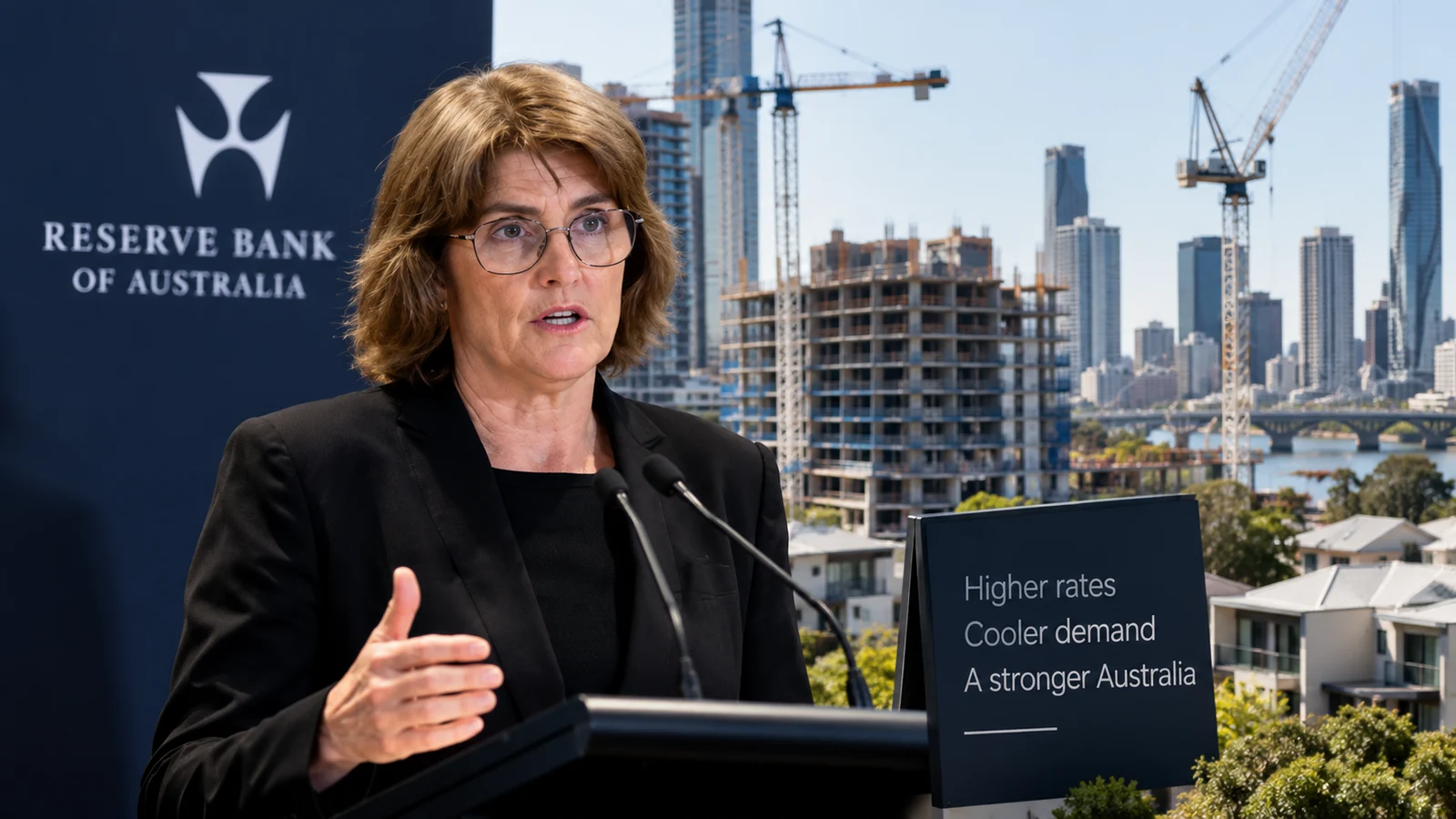
Every time inflation stays stubborn, we seem to come back to the same answer. Interest rates stay higher, mortgage repayments rise, households spend less and eventually demand is supposed to slow enough for inflation to come down.
I understand why the RBA uses interest rates. It is the main lever available to it. What I think gets far less attention is who actually carries the cost of that decision.
Australia’s banks currently have around $2.56 trillion in residential mortgage credit outstanding. A 0.25 per cent increase applied across that amount is roughly $6.4 billion a year in additional interest. A 0.5 per cent increase is around $12.8 billion. A 1 per cent increase is around $25.6 billion.
That is not a perfect measure of what every borrower pays. Some loans are fixed, some borrowers have offsets and lenders do not always pass on rate movements in exactly the same way. But it shows just how powerful interest rates are as a lever.
For a household with a $750,000 mortgage, another 0.25 per cent is roughly $1,875 a year in additional interest. That money has to come from somewhere.
It might mean spending less on restaurants, travel, renovations, cars or other household purchases. Multiply that across millions of borrowers and you can see exactly why interest rates slow the economy. That is what they are designed to do.
My question is why we focus so heavily on reducing household demand without having the same level of discussion about government demand.
The Federal Government is spending more than $800 billion a year. Australia also has a huge pipeline of state and federal infrastructure work. Queensland is moving towards another major construction cycle ahead of the 2032 Olympics, with billions of dollars to be spent on venues, transport and supporting infrastructure.
I am not arguing against infrastructure. Australia needs more housing, better transport, hospitals, energy infrastructure and productive investment. The problem is that announcing another billion dollars of spending does not suddenly create another thousand electricians, engineers, project managers or construction workers.
As a quantity surveyor, this is the part of the inflation discussion I think gets missed. Money does not build infrastructure. People, materials, equipment and productive capacity do.
If the construction industry is already stretched and government puts billions more into infrastructure, those projects compete with private development for the same resources. Contractors compete for labour. Labour rates increase. Subcontractors increase their prices. Tender prices move higher. Families building homes feel it. Developers feel it. Businesses feel it. And eventually those higher costs work their way through the economy.
The Brisbane 2032 Olympics are a good example. The Games can leave Queensland with infrastructure that provides value for decades. But between now and 2032, that spending still has to be converted into actual buildings, roads, transport and services. If construction capacity does not increase at the same time, more money can simply mean higher prices. That is inflation too.
This is why I think government spending needs to be discussed as part of the inflation problem, not separately from it. It does not mean government should slash every program or stop building. It means asking whether spending is being properly sequenced, whether we are getting value for money and whether each dollar is actually increasing the productive capacity of the economy.
There is another number worth considering. The Federal Government itself is now spending more than $40 billion a year on interest. So we have households being asked to absorb higher mortgage repayments to help slow inflation, while government is also carrying a very large interest bill of its own.
That does not mean interest rates are unnecessary. They are part of the solution. But they should not be the only part.
There are really two ways to bring demand and supply back into balance. You can reduce demand. Or you can increase supply. Interest rates mainly attack the first problem. They make people spend less. The harder question is what we are doing about the second.
Can we build more housing? Can we reduce approval times? Can we get more skilled workers into genuine shortage areas? Can we use modular construction, prefabrication and automation more effectively? Can we produce cheaper and more reliable energy? Can government and business use AI to reduce administration and improve productivity? Can we produce more with the resources we already have? That is the part of the inflation debate I think deserves more attention.
Migration also needs to be part of that discussion. Migration can be positive if we are bringing in the skills we genuinely need. Engineers, nurses, electricians and construction workers can increase the productive capacity of the economy. But if population grows faster than housing, infrastructure and services, then we are adding demand faster than supply. More people need homes. More people need transport. More people need energy. More people need healthcare. The issue is not simply migration. It is whether productive capacity is growing quickly enough to support the extra demand.
Energy is the same. If Australia can produce reliable electricity at a lower overall cost, that helps construction, manufacturing, logistics, data centres and business generally. Whether the long-term mix involves renewables, storage, gas, nuclear or other technologies is a separate policy debate. The economic objective should be simple. Make Australia cheaper and more productive to operate.
AI should be part of that as well. I have invested heavily in technology within my own businesses because I believe the opportunity is much bigger than using AI to write emails. Businesses should be using technology to identify where margins are being lost, where labour is being wasted and where repetitive work can be removed. Government should be doing the same.
AI should be helping analyse procurement, identify cost overruns earlier, review variations, compare contractor performance and remove duplicated administration. That is where the productivity gains are. If we can produce more houses, infrastructure, healthcare and services from the resources we already have, then we increase the capacity of the economy instead of simply suppressing demand. That is a much healthier way to bring inflation down over the long term.
Interest rates will always have a role. I am not suggesting otherwise. But making a mortgage more expensive does not build another house. It does not create another electrician. It does not produce another megawatt of electricity. It does not make a construction project more efficient. It simply forces the person carrying the debt to spend less.
For property owners, this comes back to something I keep talking about. Buying the property is one decision. Holding it through changing rates, government policy, employment and economic cycles is the much bigger challenge. If we want Australians to keep holding property, investing and building businesses, then we should also be asking whether too much of the inflation fight is being pushed onto the people carrying the debt.
The conversation should not only be about how much higher rates need to go. It should also be about how government spends better, how businesses become more productive, how we build more efficiently and how Australia increases supply without simply relying on households to spend less.
“Property is bought once. It has to be held every day.”
Explore further
Related commentary
Frameworks & tools
Republishing
You're welcome to republish this article in full or in part, provided it includes clear attribution to Mark Kilroy and a link back to the original at markkilroy.com.au.
For media enquiries, syndication requests, or to discuss republishing in print or digital publications, please get in touch.
The Kilroy Brief
One practical briefing on the policy, tax, cost and cash-flow forces shaping Australian property ownership. For owners, investors and advisers who want the mechanics behind the headlines. Sent when there is something worth saying, not to fill a schedule.