AI Is Booming. But What Does Australia Actually Get Back?
AI data centres promise billions in investment, but Australia also supplies the land, electricity, infrastructure and construction capacity. Mark Kilroy argues that each project should face a national return test measuring ownership, permanent jobs, exports, local capability, infrastructure contributions and the long-term value Australia retains.

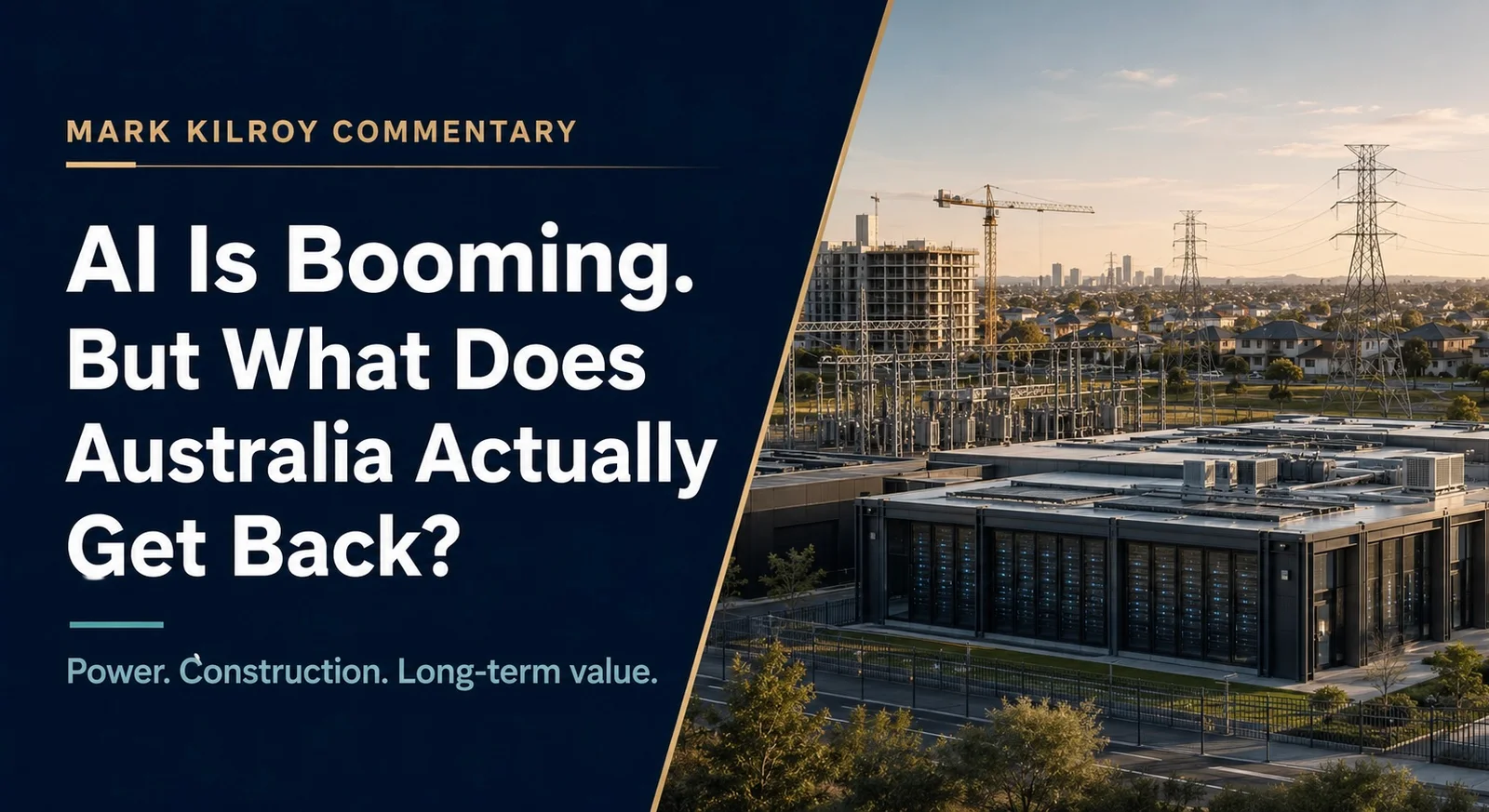
AI is booming. The infrastructure behind it is arriving quickly. But Australia needs to ask a harder question than how much is being invested.
What does Australia actually get back?
I had a conversation with another Quantity Surveyor this week who is now involved in building data centres.
Around the same time, I listened to Ed Zitron talking with Steven Bartlett about the economics of AI.
Zitron is much more sceptical about AI than I am.
I have been an early adopter. I have seen firsthand how much AI can improve a business, accelerate analysis and help people do better work.
So I am not questioning the technology.
I am questioning the cost of the infrastructure behind it, and whether Australia is thinking clearly enough about the return.
AI Has a Physical Balance Sheet
When I look at a data centre as a Quantity Surveyor, I do not just see artificial intelligence.
I see land, buildings, substations, cooling systems, electrical infrastructure, transmission capacity and a very large construction cost.
AI may feel weightless when we use it through a browser, but the systems supporting it are intensely physical.
They consume capital, electricity, water, skilled labour, construction materials and scarce infrastructure capacity.
Those costs sit somewhere. They compete with something. They create value for someone.
Thirteen Per Cent of NEM Electricity
AEMO's 2026 data-centre forecasting overview says consumption across the National Electricity Market could grow nearly sevenfold to around 34 terawatt hours, or 13 per cent of forecast operational consumption, by the 2036 financial year.
That is a huge amount of power.
It means the AI discussion cannot be separated from energy policy, grid investment or the cost and reliability of electricity for households and other industries.
The question is not whether data centres should be connected.
The question is whether the infrastructure, pricing and policy settings around them ensure Australia is strengthened by their growth rather than simply carrying more of the cost.
The Collision With Housing and Infrastructure
Data centres need many of the same electricians, engineers, contractors, transformers, switchgear and construction materials that Australia needs for housing, transport and essential infrastructure.
That creates opportunity for Australian businesses and workers.
But it can also intensify competition for already constrained skills and materials. That can push construction costs higher and make delivery timelines harder across the wider economy.
Australia is already struggling to build enough housing.
If a new wave of high-value infrastructure demand draws heavily from the same limited workforce and supply chain, we need to understand the trade-offs rather than assume every project is an uncomplicated gain.
Investment Is Not the Same as Wealth Creation
We keep hearing about billions of dollars being invested in Australian data centres.
That sounds positive, and part of it certainly is.
Construction activity creates work. New infrastructure can attract customers and support digital industries. Better computing capacity can improve productivity.
But the size of an investment announcement is not the same as the amount of long-term wealth Australia retains.
If much of the equipment is imported, the core technology is foreign owned and a large share of the long-term profits flows offshore, then the headline capital expenditure tells only part of the story.
Australia may provide the land.
We may provide the buildings.
We may provide the workforce.
We may provide the electricity.
But what do we actually get back?
A National Return Test
Every major data-centre proposal should be assessed against a transparent national return test.
- How much Australian value will be created and retained?
- How many permanent, high-value jobs will remain after construction?
- How much export income will the facility generate?
- Who owns the land, infrastructure and operating business?
- How much Australian capability and intellectual property will be developed?
- What contribution will the project make to new energy and network capacity?
- What pressure will it place on housing, construction costs, water and critical skills?
- What tax revenue and broader productivity gains can Australia reasonably expect?
This is not an argument for blocking investment.
It is an argument for measuring it properly.
A project can be commercially successful and still leave Australia with an inadequate return after the full cost of land, energy, infrastructure and economic displacement is considered.
From Host Country to Participant
Australia should not be satisfied with becoming a passive host for the physical infrastructure of the AI economy.
We should be building domestic skills, local supply chains, Australian ownership, research capability and businesses that use this infrastructure to create exportable value.
The stronger position is not simply to house the servers.
It is to participate meaningfully in the value those servers create.
That requires clearer policy, better measurement and a willingness to look beyond the construction phase.
The Question Australia Should Ask Now
I believe AI will continue to transform business.
I am already seeing that myself.
But as someone who has spent his career looking at cost versus value, I think Australia needs to look beyond the size of each investment announcement.
The real question is not how much is being spent.
It is how much long-term value Australia actually keeps.
“Property is bought once. It has to be held every day.”
Sources
Frequently Asked Questions
How much electricity could Australian data centres consume?
AEMO's 2026 forecasting overview says data-centre consumption in the National Electricity Market could grow nearly sevenfold to around 34 TWh, or 13 per cent of forecast operational consumption, by FY36.
Why can data-centre growth affect housing construction?
Data centres compete for many of the same electricians, engineers, contractors, transformers, switchgear and construction materials needed for housing and public infrastructure. In a constrained market, that competition can increase costs and extend delivery times.
Why is investment different from national wealth creation?
Capital expenditure measures what is spent on a project. National wealth creation also considers where equipment comes from, who owns the assets, where profits flow, what permanent jobs remain and how much export income and local capability are created.
What is the proposed national return test for data centres?
It is a transparent assessment of Australian ownership, retained value, permanent jobs, export income, local skills and intellectual property, energy and network contributions, tax revenue and pressure on housing and construction capacity.
Is this an argument against AI or data-centre investment?
No. The argument is that Australia should measure the full cost and long-term return of major projects rather than treating the announced investment figure as proof of national benefit.
Explore further
Related commentary
Frameworks & tools
Republishing
You're welcome to republish this article in full or in part, provided it includes clear attribution to Mark Kilroy and a link back to the original at markkilroy.com.au.
For media enquiries, syndication requests, or to discuss republishing in print or digital publications, please get in touch.
The Kilroy Brief
One practical briefing on the policy, tax, cost and cash-flow forces shaping Australian property ownership. For owners, investors and advisers who want the mechanics behind the headlines. Sent when there is something worth saying, not to fill a schedule.