Anti-Dumping Duties Protect Local Makers. So Who Pays for Them in the Price of a New Home?
Mark Kilroy follows up his October commentary on Chinese windows and doors, looks at five building materials now under investigation, and asks who the duties help and who ends up carrying the cost.

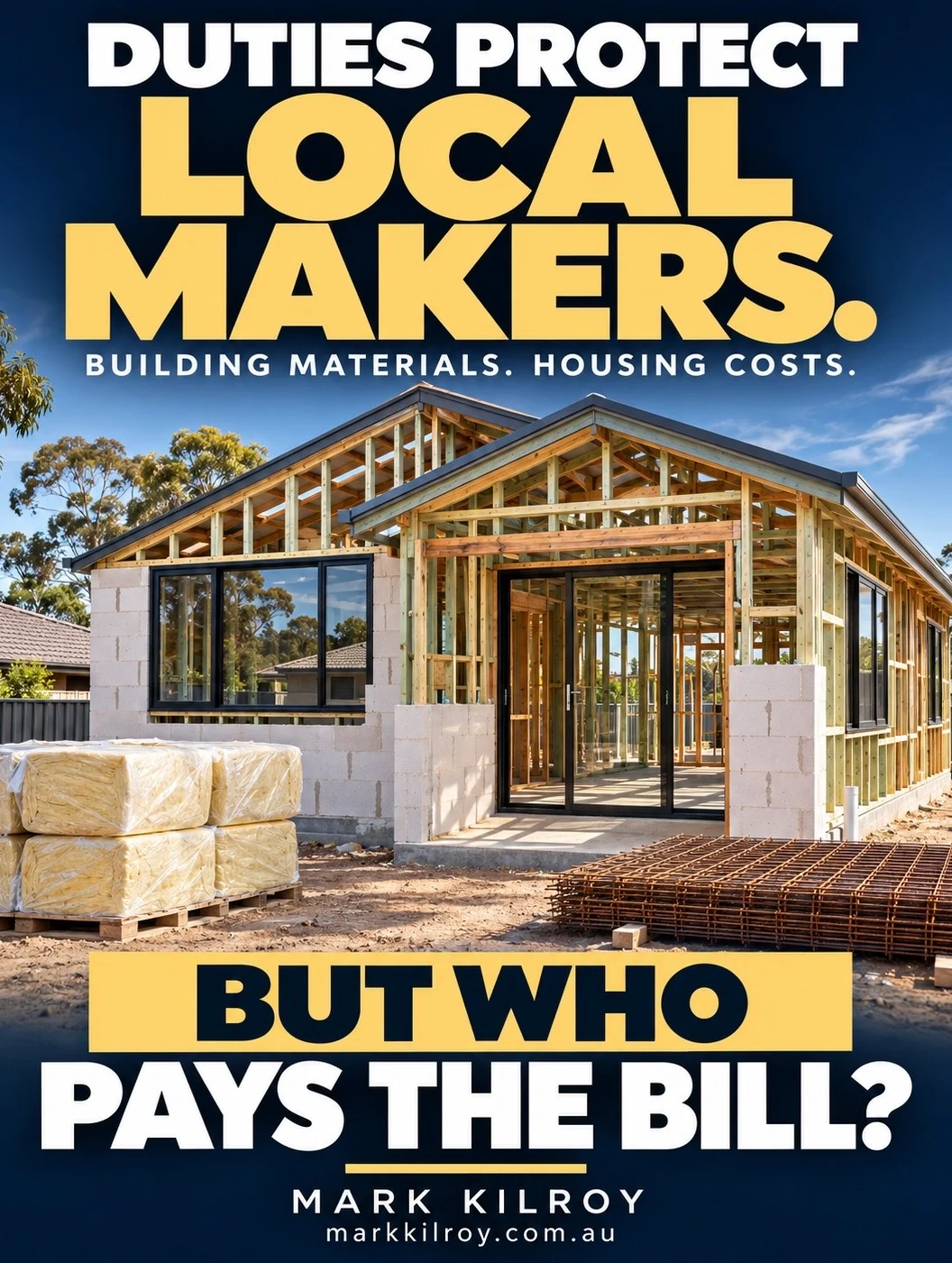
In October I wrote about the securities importers now have to lodge on aluminium windows and doors from China, at rates from 5.3% to 73.3%. At the end of that piece I asked a simple question. Has anyone actually calculated the cumulative effect of these measures on the cost of building a new home?
I haven't found anyone who has. So, as a Quantity Surveyor, I had a go myself.
It isn't just windows any more
Since my first article the list has grown. Alongside windows and doors, the Australian Trade Remedies Commission (formerly the Anti-Dumping Commission) is now investigating glass wool insulation batts from China and Malaysia, structural timber including LVL from China, aerated concrete blocks and panels from China, and welded steel mesh from China. Importers of mesh have been lodging securities of 28.5% to 45.4% since August.
That is the frame, the windows, the insulation, the slab mesh and in some homes the walls, all under investigation at the same time. That's on top of the duties that have applied for years to steel sections, reinforcing, hollow sections and aluminium extrusions, which are already built into today's prices.
Who the duties are designed to help
The duties are designed to help Australian manufacturers and the people they employ. The windows and doors case was brought by Ventora Group and the Australian Glass and Window Association, with local makers including G James and Dowell providing data to the Commission. The Timber, Furnishing and Textiles Union supports it. The insulation case was brought by CSR and Fletcher, and the aerated concrete case by CSR.
Their argument is a fair one. The Commission found that windows and doors from China were being sold here below their normal value, and that local makers had lost around $422.6 million as a result, mostly through being undercut on price. Australia should have businesses making building products, and dumping is a specific finding under trade law, not just a case of imports being cheaper.
Who carries the cost
The homeowner isn't who the duties are designed to help, and that is the part of the trade-off I don't think is getting enough attention.
When an imported product gets dearer, the cost moves down the chain. First it lands on the builder, who may have signed a fixed-price contract before the securities started on 15 October. Then it flows to the next buyer through a higher build price. For investors, it ends up in the rent. And when local makers face less price competition, they can lift their own prices towards the new import price too, so the cost can reach buyers who never touch an imported product.
What it could add to a house
I've costed it the way I would cost any building, element by element. On my estimate, if only imported goods get dearer, the duties add about $2,000 to a typical $517,000 new house. If local suppliers also lift their prices, it is closer to $15,000.
The graphic below shows the extreme end. If every material were imported and every case passed at the top rates being claimed or preliminarily found, the extra materials cost would be about $41,500. Structural timber drives most of that, and its 143% rate is only what the applicants allege, so treat it as a ceiling, not a forecast.
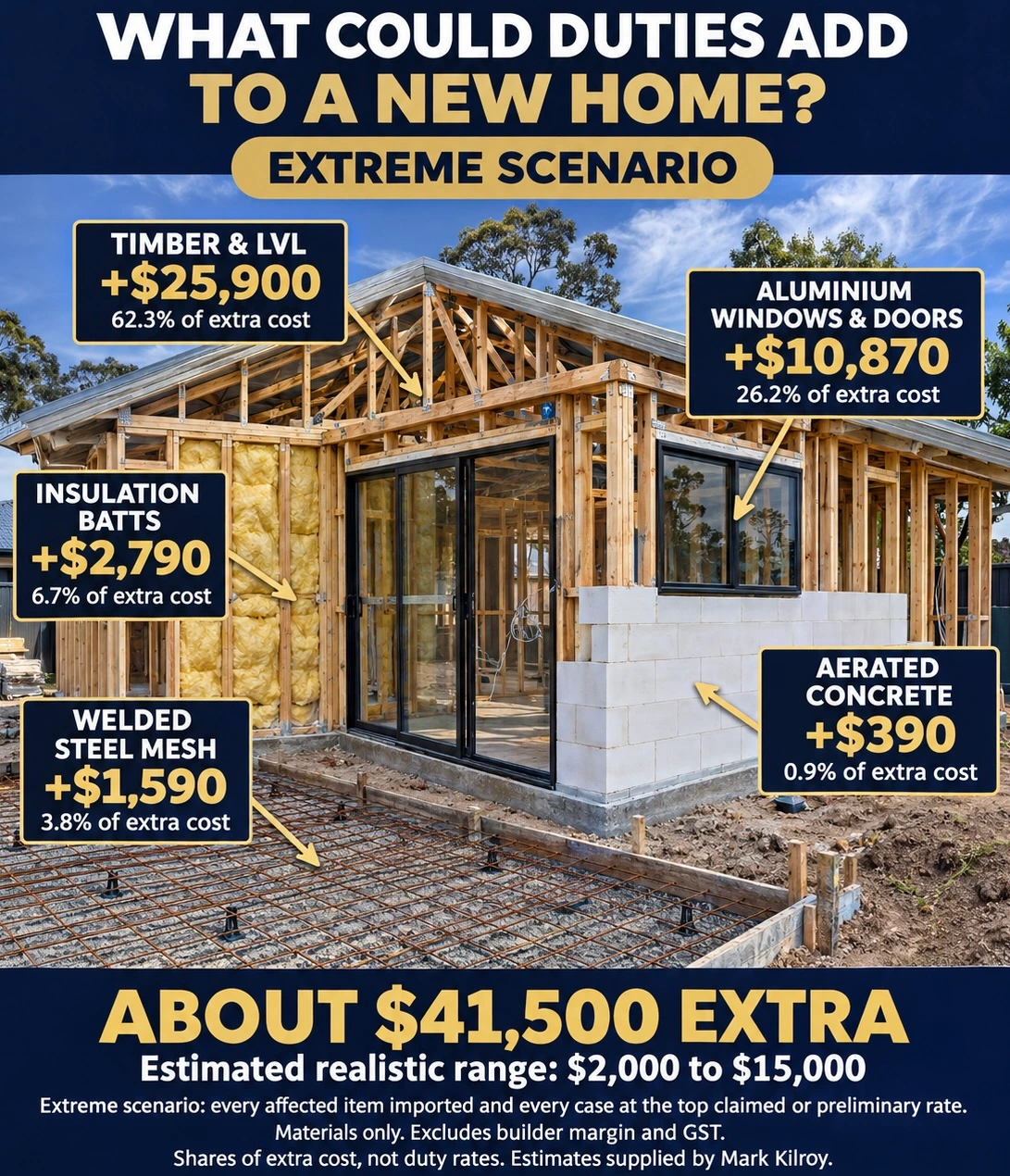
If builders pass these costs on with their margin and GST, add about 20% to whichever figure you use.
Apartments and commercial buildings carry more
These figures are for a detached house. Apartments, shopfronts, childcare and medical centres, and industrial buildings generally use more aluminium windows and doors, and more of them are imported. Curtain wall is excluded from the windows case, so fully glazed office towers are largely outside it, but mid-rise apartments are squarely in it. That is exactly the kind of project where, as I wrote in October, a small cost increase can be enough to stop it going ahead.
Nobody is required to weigh it up
This is the part that surprised me most. The Commissioner has said in writing that the law does not allow him to undertake a public interest test or assess the overall economic impact. Only the Minister can weigh that up, when deciding whether to impose the duties. The Productivity Commission recommended a public interest test back in 2009.
So each case is decided on its own, and no one is required to add them up for a single house.
What happens next
The final report on windows and doors is due by 16 December, with a decision from the Minister expected in the new year. The mesh recommendation is due by 3 December. The insulation, timber and aerated concrete cases run into 2027.
I'm not arguing against local manufacturing. I'm asking for the trade-off to be measured before the decisions are made. Protecting local jobs and building more homes are both worthwhile goals, and the cost of one shouldn't be invisible when we decide the other.
Who ultimately carries the cost? On the evidence so far, it isn't the businesses asking for protection.
I'd be interested to hear from builders, developers, suppliers and other Quantity Surveyors. Are you seeing these securities in your quotes yet?
“Property is bought once. It has to be held every day.”
Sources
- Mark Kilroy, "Australia Just Hit Chinese Windows and Doors With Charges of Up to 73.3%", October 2026 (the earlier article).
- Australian Trade Remedies Commission, Investigation 691, preliminary findings notice TRN 2026/147: securities of 5.3% to 73.3% from 15 October 2026.
- Australian Trade Remedies Commission, Statement of Essential Facts 691: applicants and supporting local makers (s 2.4), $422.6 million injury estimate (p.17), and the Commissioner's statement that he cannot undertake a public interest test (s 2.4.12).
- Australian Trade Remedies Commission, Case 691 record: goods description including the curtain wall exclusion, and industry submissions.
- Timber, Furnishing and Textiles Union, response to SEF 691, 3 November 2026.
- Australian Trade Remedies Commission, current cases: insulation batts (723, CSR and Fletcher), structural timber and LVL (724), aerated concrete (725, CSR), welded steel mesh (692).
- Consideration report 723 (batts, alleged rates up to 80%).
- Consideration report 724 (timber, alleged margins 40.12% to 143%).
- Consideration report 725 (aerated concrete, alleged 14% dumping plus subsidy above 2%).
- Statement of Essential Facts 692 (mesh securities 28.5% to 45.4%, final recommendation due 3 December 2026).
- Australian Trade Remedies Commission, Case 692 record (welded steel mesh).
- Australian Trade Remedies Commission, Dumping Commodity Register (existing steel and aluminium extrusion measures).
- Productivity Commission, anti-dumping inquiry, 2009 (public interest test recommendation).
- $517,000 typical new house: ABS average house approval value for the 2025–26 financial year, from the ABS media release 'Dwelling approvals rise in June 2026', 30 July 2026.
Explore further
Related commentary
Frameworks & tools
Republishing
You're welcome to republish this article in full or in part, provided it includes clear attribution to Mark Kilroy and a link back to the original at markkilroy.com.au.
For media enquiries, syndication requests, or to discuss republishing in print or digital publications, please get in touch.
The Kilroy Brief
One practical briefing on the policy, tax, cost and cash-flow forces shaping Australian property ownership. For owners, investors and advisers who want the mechanics behind the headlines. Sent when there is something worth saying, not to fill a schedule.