Sydney Office Rents Are Rising 8%. So Why Are Billions in Commercial Property Facing an Uncertain Future?
Sydney’s premium office rents have risen 8.3% over the past year.

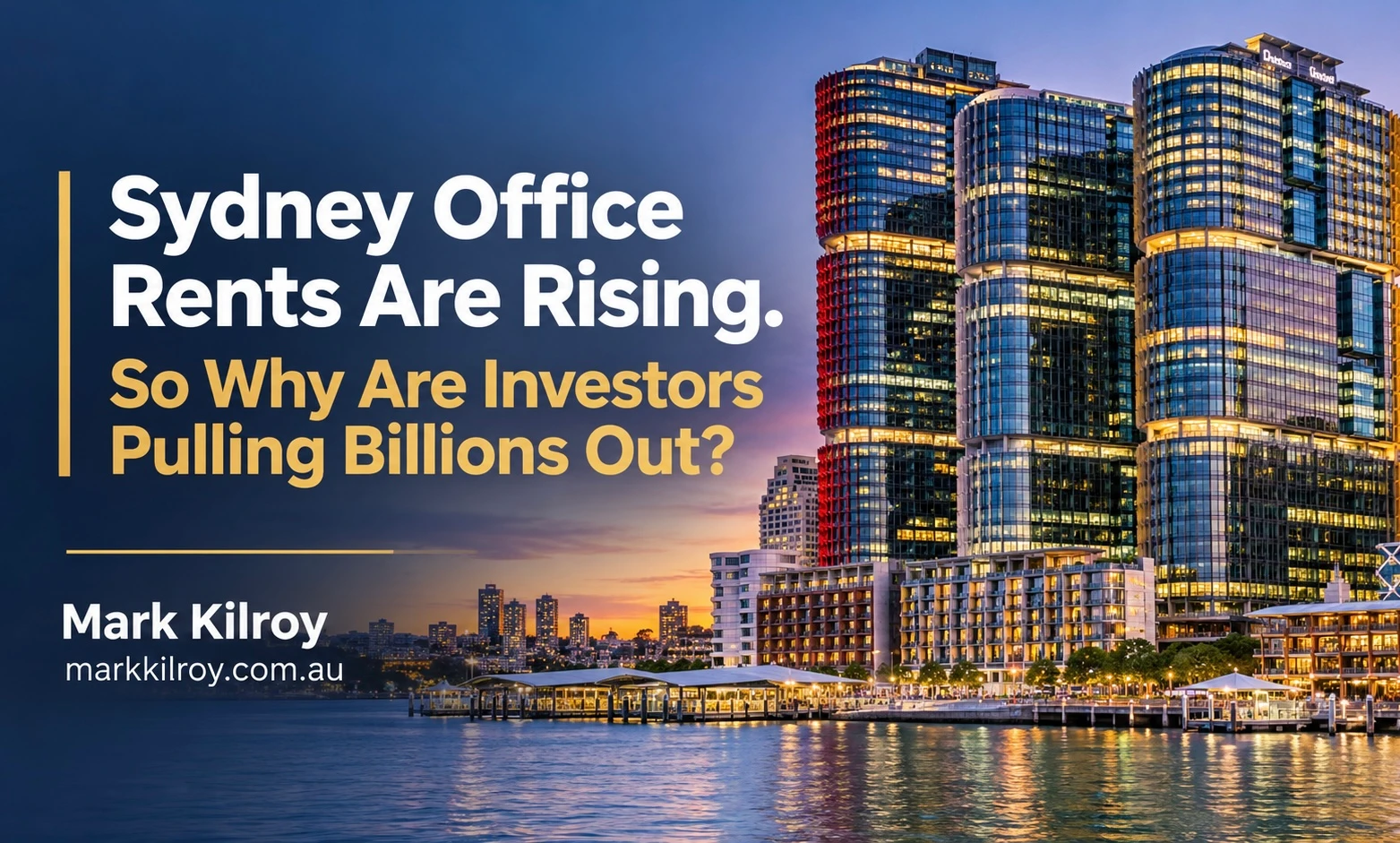
Sydney’s premium office rents have risen 8.3% over the past year.
New office towers are becoming increasingly difficult to justify financially.
Yet this week, Lendlease found itself facing the potential loss of two major property funds holding around $8 billion in office buildings and industrial assets.
Something doesn’t quite add up.
Or perhaps it does, when you look beyond the buildings themselves.
The Buildings Haven’t Changed. The Investors Have.
Reports this week suggest investors in two Lendlease-managed Australian property funds are looking to withdraw their capital.
The funds hold approximately $5.8 billion in office assets and $2 billion in industrial property.
Hostplus has confirmed its intention to redeem its investment, with other investors potentially following.
The deadline for redemption requests is 27 November.
Whether the funds are eventually wound up remains to be seen, but the implications could be significant.
These are not necessarily poor-quality buildings. Some are major institutional assets in established commercial locations.
The issue is that the investors who own them may now have different priorities.
They want liquidity. They want to redeploy capital. They may no longer want their money tied up in the same investments.
And that brings me to something I believe is often overlooked when we discuss commercial property.
A good building doesn’t necessarily mean a good investment at any price, and a good investment doesn’t mean its owner can afford to keep holding it.
Property values, rental income, financing costs and investor liquidity are four different things.
They don’t always move in the same direction.
Meanwhile, Sydney Is Running Out of New Office Towers
According to JLL, prime gross effective office rents in Sydney’s CBD increased 8.3% over the 12 months to September 2026.
Demand for quality space has strengthened.
But where is the next generation of office buildings coming from?
55 Pitt Street, Chifley South and Atlassian Central represent the major developments currently progressing through the Sydney CBD pipeline.
Beyond those projects, the supply outlook is extremely limited.
Mirvac recently confirmed its 55 Pitt Street tower had topped out, with an estimated completed value of approximately $2 billion.
It is an extraordinary investment in a single building.
And it raises an obvious question.
If office rents are rising, why aren’t developers rushing to build more towers?
This Is Where Construction Economics Come Into It
As a quantity surveyor, I look at this from a different perspective.
Before anyone commits hundreds of millions of dollars to a development, the numbers have to work.
That means accounting for land acquisition, construction, professional fees, approvals, finance, leasing incentives, holding costs and development risk.
And construction costs are only one part of that equation.
A new office tower must generate sufficient income and an acceptable return to justify the total investment.
If the completed building is not expected to be worth enough relative to what it costs to deliver, the project simply doesn’t proceed.
It doesn’t matter how impressive the architectural drawings look.
It doesn’t matter how badly the city needs additional office space.
And it doesn’t matter how ambitious the developer might be.
If the numbers don’t stack up, the building doesn’t get built.
That is the commercial reality.
What Happens to the Buildings We Already Have?
This is where the situation becomes particularly interesting for existing property owners.
If quality commercial space is in demand, rents are increasing and the cost of delivering replacement buildings remains high, existing properties may become increasingly attractive.
They are already built.
They can already generate income.
And their owners don’t necessarily have to take on the enormous financial risk of developing something new.
I have experienced the benefits of long-term commercial property ownership myself, having purchased my own office premises through my self-managed super fund several years ago.
The property has experienced substantial growth in value over that time.
But ownership is not without costs.
There were establishment expenses, professional fees and ongoing reporting and compliance obligations associated with the SMSF, along with the responsibilities of owning commercial property.
That experience has reinforced something I have always believed about property investment.
The purchase price is only the beginning. What matters is the cost of ownership, the income generated, the financing arrangements and the long-term value of the asset.
And even when a property performs well, the owner still needs the financial capacity to hold it.
This is why the situation facing Lendlease’s funds is worth watching.
Investors may want their capital returned at precisely the time when replacement costs are making new development more challenging.
There Could Be a Bigger Problem Ahead
If significant commercial property funds are wound up or forced to sell assets, those transactions could put pressure on market values, particularly if substantial volumes of property are offered for sale over a short period.
But there is another consequence.
If institutional investors become more cautious and the development market loses potential buyers for completed projects, how many new towers will actually proceed?
Higher rents should eventually encourage new development.
But what happens when the cost of construction and financing has risen so much that even stronger rental income is not enough?
We may end up with a market where existing premium buildings benefit from limited supply, while the next generation of developments struggles to get off the ground.
And that ultimately affects tenants, businesses and the broader economy.
We Need to Look Beyond Property Prices
I think we spend too much time talking about whether commercial property values are rising or falling.
The more important questions are often what a building costs to replace, what income it can realistically generate and whether the owner has sufficient capital to hold it.
The problems facing a major property fund are very different from those facing someone who owns a small commercial office.
But the underlying financial principles are not.
Cash flow matters. Financing matters. Holding costs matter.
And the value of an asset on paper does not necessarily tell you how financially secure its owner is.
The Lendlease situation is still developing, and the outcome for its property funds is far from certain.
But the bigger issue is already apparent.
Sydney needs quality commercial space. Rents are rising. Yet the economics of developing new office towers remain challenging.
At the same time, some institutional investors are looking to exit the buildings that already exist.
So here is the question I would be asking.
If existing investors want their money back, and new developments are becoming too expensive to build, who is going to finance the next generation of Australian office towers?
And what will that mean for the price of commercial property we already have?
“Property is bought once. It has to be held every day.”
Explore further
Related commentary
Frameworks & tools
Republishing
You're welcome to republish this article in full or in part, provided it includes clear attribution to Mark Kilroy and a link back to the original at markkilroy.com.au.
For media enquiries, syndication requests, or to discuss republishing in print or digital publications, please get in touch.
The Kilroy Brief
One practical briefing on the policy, tax, cost and cash-flow forces shaping Australian property ownership. For owners, investors and advisers who want the mechanics behind the headlines. Sent when there is something worth saying, not to fill a schedule.