Before Australia Promises More Homes, Show Us the Cost Plan
Australia's housing debate is fixated on supply: more land, more approvals, more density, more targets. But after 25 years across construction cost, property and taxation, Mark Kilroy argues we are avoiding the most important question: what does it actually cost to turn land into a completed home, and how much of the final price is not the land or the building? Every major construction project begins with a cost plan. Australia has housing targets. Where is the cost plan?

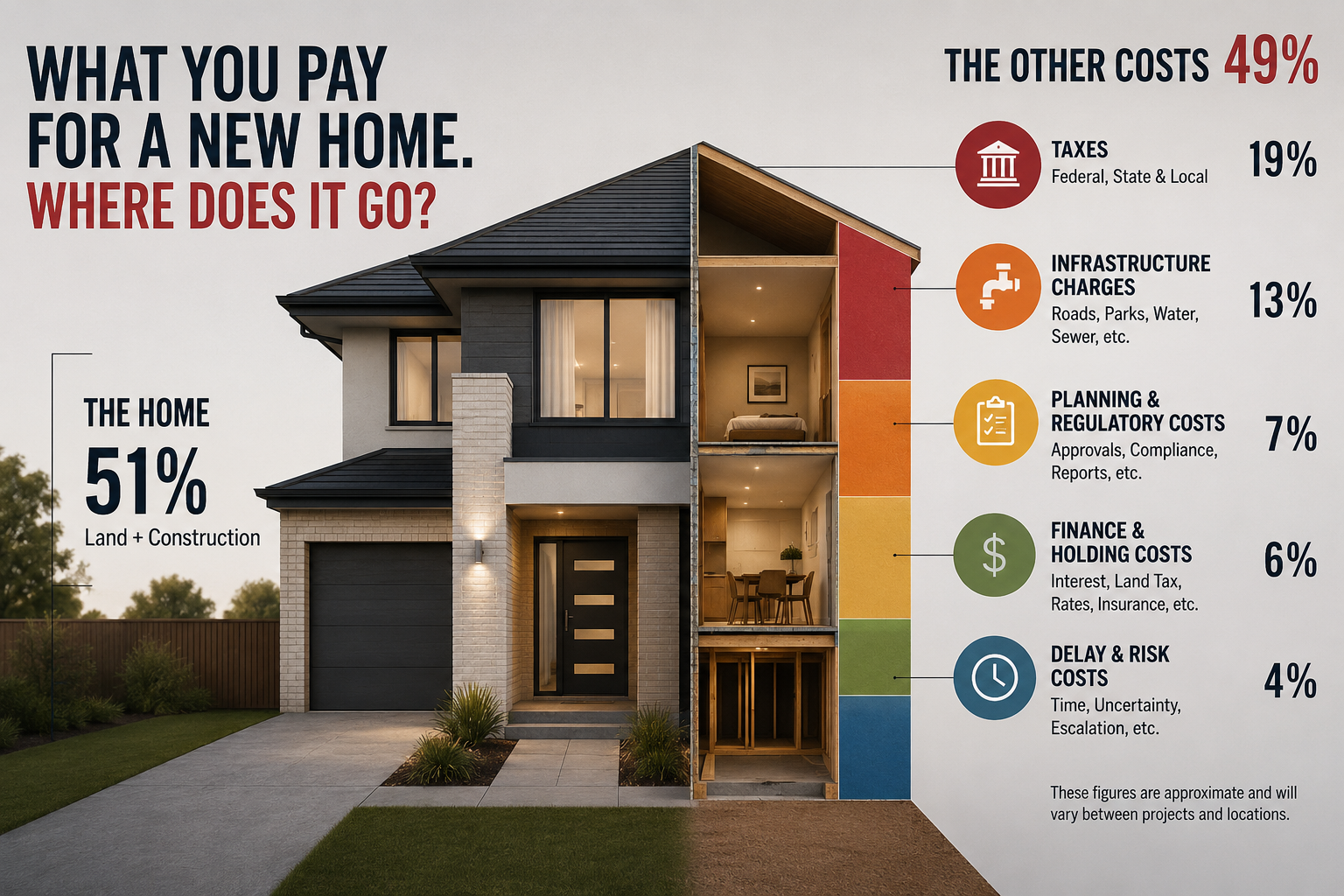
Australia's housing debate continues to focus on supply.
More land.
More approvals.
More density.
More modular construction.
More housing targets.
But after more than 25 years working across construction cost, property and taxation, I believe we are avoiding the most important question.
What does it actually cost to turn land into a completed home, and how much of that final price is not paying for the land or the physical building?
The Conversation Happening in Private
I work with developers, builders, consultants and property owners every day.
Many understand exactly why projects are not proceeding.
The issues are discussed privately: rising construction costs, infrastructure charges, approval delays, finance costs, regulatory requirements and the growing gap between what a project costs to deliver and what buyers can afford to pay.
Many developers will not speak publicly about this.
They still need approvals, funding and ongoing relationships with government authorities.
I will.
Why I Am Speaking Up
Not because every tax or charge is unjustified.
Not because development should avoid contributing to infrastructure.
And not because safety, quality or energy efficiency do not matter.
I am speaking because there is almost no transparency in what a new home actually costs.
Where Is the Cost Plan?
Every major construction project begins with a cost plan.
Before a builder is engaged, before finance is approved, before a single trade is priced, someone sits down and accounts for every dollar it will take to deliver the project.
Australia has housing targets.
Where is the cost plan?
If we are serious about delivering more homes, Australians deserve a transparent, line-by-line account of what it costs to turn land into a completed home, and how much of the final price is something other than the land and the physical building.
Because a target without a cost plan is not a plan. It is a promise.
“Property is bought once. It has to be held every day.”
Frequently Asked Questions
What is the central question this article asks about Australia's housing targets?
What does it actually cost to turn land into a completed home, and how much of that final price is not paying for the land or the physical building? The article argues Australia has housing targets but no transparent cost plan behind them.
Why don't developers speak publicly about why projects are not proceeding?
Because they still need approvals, funding and ongoing relationships with government authorities. The barriers, including rising construction costs, infrastructure charges, approval delays, finance costs and regulatory requirements, are widely understood but discussed privately.
Is this article arguing against infrastructure charges or building standards?
No. It does not claim every tax or charge is unjustified, that development should avoid contributing to infrastructure, or that safety, quality and energy efficiency do not matter. The argument is that there is almost no transparency in what a new home actually costs.
What is a cost plan and why does it matter for housing policy?
A cost plan is the line-by-line account of every dollar required to deliver a construction project, prepared before a builder is engaged or finance is approved. The article argues housing targets announced without an equivalent transparent costing are promises, not plans.
Explore further
Related commentary
Frameworks & tools
Republishing
You're welcome to republish this article in full or in part, provided it includes clear attribution to Mark Kilroy and a link back to the original at markkilroy.com.au.
For media enquiries, syndication requests, or to discuss republishing in print or digital publications, please get in touch.
The Kilroy Brief
One practical briefing on the policy, tax, cost and cash-flow forces shaping Australian property ownership. For owners, investors and advisers who want the mechanics behind the headlines. Sent when there is something worth saying, not to fill a schedule.