Thousands of SMSF Home Contracts Could Be Cancelled. The Real Damage May Be the Projects That Never Start
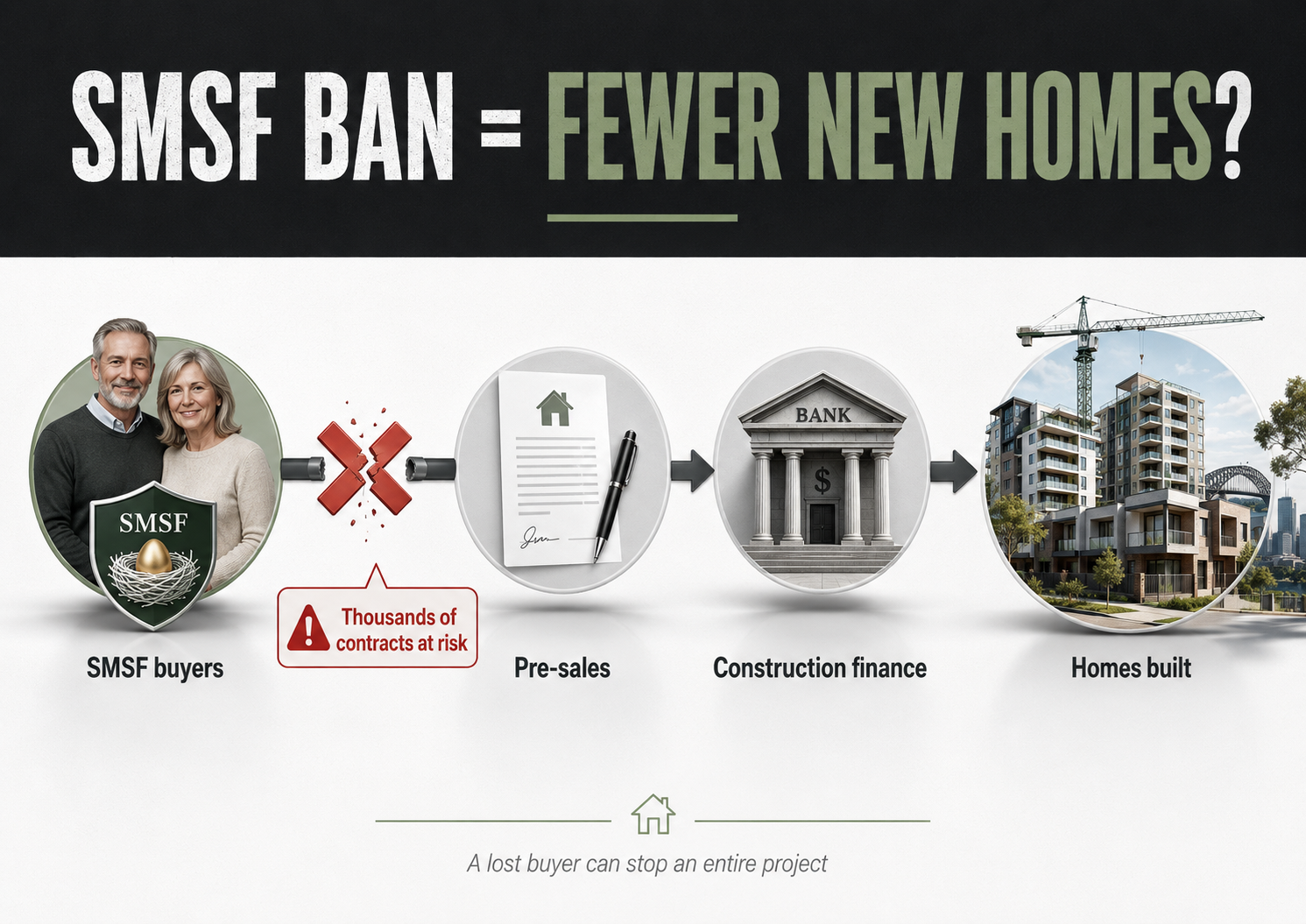
Parliament has banned SMSFs from new limited recourse borrowing for residential property. Builders report 3,613 signed contracts for unbuilt homes are at risk, with 2,415 expected to be cancelled. Mark Kilroy argues the greater damage is hidden: lost pre-sales can push whole developments below their construction finance thresholds, so the projects that never start may cost far more homes than the contracts cancelled today. A targeted new-housing exemption would fix the inconsistency.

Australia needs more homes.
That is the one point almost everyone agrees on.
We have a national target of 1.2 million new homes over five years, requiring around 240,000 commencements every year. Yet only 184,460 dwellings commenced in the 12 months to September 2025. We were already well behind before the latest policy change.
Against that background, Parliament has introduced a restriction that the residential construction industry warns could cancel thousands of signed contracts for new homes.
Not contracts for established properties.
Contracts for homes that have not yet been built.
The change prevents self-managed superannuation funds from entering new limited recourse borrowing arrangements to purchase residential property. Borrowing remains available for qualifying business real property, but not residential housing.
The measure was added to the Government’s broader tax legislation following negotiations with the Greens.
It was promoted as closing a loophole that allowed wealthy property investors to use SMSFs to acquire tax-advantaged investment properties.
That may make for a simple political message.
The housing market is not that simple.
The Contracts Already at Risk
The Housing Industry Association recently surveyed major detached-home builders representing more than 40 per cent of Australia’s detached housing construction.
Those builders reported:
- 3,613 signed contracts involving SMSF limited recourse borrowing arrangements where construction had not commenced
- 2,415 contracts, or 66.9 per cent, expected to be cancelled
- more than 70 per cent already experiencing a decline in investor enquiries
- almost 90 per cent expecting the change to reduce housing commencements during 2026 and 2027
These are industry estimates and should be tested against Treasury’s own modelling.
The problem is that no detailed government assessment of the housing supply impact has been publicly released.
That leaves an obvious question.
Before agreeing to this amendment, did the Government know how many new homes would no longer proceed?
If the modelling exists, it should be published.
If it does not exist, Parliament has made a significant housing supply decision without properly understanding the consequences.
An Established Home Is Not the Same as a New Home
The restriction treats residential property as one category.
From a housing supply perspective, it is not.
An SMSF purchasing an established house changes the ownership of an existing dwelling. It does not create another home.
An SMSF signing a contract for a new house-and-land package, townhouse or off-the-plan apartment can help fund a dwelling that does not yet exist.
That distinction matters.
It is also a distinction the Government has recognised elsewhere.
From 1 July 2027, negative gearing will be limited for affected residential investments, but new builds will continue to receive different treatment because the stated objective is to direct investment towards additional supply.
Why has the same principle not been applied to SMSF borrowing?
If investment in new housing is worth preserving under the negative gearing reforms, why is it being prohibited through an SMSF limited recourse borrowing arrangement?
The policy is inconsistent.
One Cancelled Contract Can Affect More Than One Home
This is the part of the debate that has largely been missed.
Residential projects do not commence simply because a developer owns a site, has planning approval and appoints a builder.
Most projects require construction finance.
Before providing that finance, banks and non-bank lenders generally require evidence that enough purchasers are committed to the development. This is usually demonstrated through qualifying pre-sales.
Those pre-sales provide confidence that purchasers will settle when construction is complete and that the lender can be repaid.
SMSF investors form part of that buyer market.
Remove one SMSF purchaser and one sale may be lost.
Remove enough purchasers and the developer may fall below the lender’s pre-sale requirement.
At that point, the effect is no longer limited to the apartments, townhouses or homes those investors intended to purchase.
The entire project may not proceed.
Twenty cancelled contracts do not necessarily mean twenty fewer homes.
They could mean that a project of one hundred homes never reaches construction finance.
That is the hidden multiplier.
The contracts being cancelled today are visible.
The developments that quietly fail feasibility, lose funding or never reach site will be much harder to count.
They may also represent the greater long-term loss.
These Investors Are Not a Political Stereotype
The Greens have described the affected group as wealthy property investors exploiting a loophole.
That description will not reflect every SMSF trustee caught by the change.
Many are business owners, professionals, tradespeople and couples approaching retirement who have spent decades building their superannuation balance.
They chose to establish an SMSF because they wanted more control over how their retirement savings were invested.
They also accepted the additional responsibilities that come with that decision.
They are required to operate a regulated superannuation structure, satisfy compliance obligations, prepare financial statements, arrange an annual audit and ensure investments comply with the sole-purpose test.
For some, a newly constructed residential property was intended to provide a long-term rental income stream and an asset to support their retirement.
They were not necessarily trying to build a large property empire.
They were trying to become less dependent on the age pension.
Those Australians are now being told that they can continue managing their own superannuation, but one of the investments they may have specifically established the fund to acquire is no longer available through borrowing.
Some had already signed contracts.
Some had paid deposits.
Some had entered building arrangements based on the law operating at the time.
The speed of the change matters because property transactions and development contracts do not move at the speed of Parliament.
SMSFs Are Not a Fringe Part of Superannuation
Self-managed super is a major part of Australia’s retirement system.
At 30 June 2025, SMSFs held approximately $1.1 trillion, representing 24.3 per cent of Australia’s $4.3 trillion superannuation system. APRA-regulated funds held around $3 trillion.
That means almost one-quarter of Australian superannuation assets is controlled through self-managed funds rather than directly through large industry and retail institutions.
We should not claim that large super funds have simply “lost” the entire $1.1 trillion to SMSFs. Much of that balance reflects accumulated contributions and long-term investment growth.
However, the commercial significance is clear.
Every dollar transferred from an institutional super fund into an SMSF is money that the previous fund no longer manages and no longer earns administration or investment fees from.
There is no clear public evidence that the large super funds designed or demanded this residential borrowing restriction.
That claim should not be made without proof.
But the practical effect still deserves scrutiny.
Restricting residential borrowing may discourage some Australians from establishing an SMSF or cause them to question whether the cost and administration of continuing one remain worthwhile.
More retirement capital may therefore remain under institutional management.
At the same time, institutional superannuation funds can continue gaining exposure to residential property through property funds, development finance, shared-equity structures and build-to-rent investments.
That creates an obvious inconsistency.
Why is residential property an acceptable investment when controlled by a large institution, but unacceptable when an Australian chooses to invest directly through a regulated SMSF?
The underlying property exposure may be similar.
What changes is who controls the capital.
The Government Says SMSF Borrowing Is Only a Small Part of the Market
The Treasurer has argued that SMSF borrowing represents less than one per cent of total residential property borrowing and less than half of one per cent of new residential borrowing each year.
On the surface, that sounds reassuring.
But total lending volume is not the only measure that matters.
In development finance, the timing and location of the capital are critical.
A relatively small pool of purchasers can have a disproportionate effect if those buyers are concentrated in new house-and-land estates, townhouse developments or off-the-plan projects where pre-sales determine whether construction finance is available.
The relevant question is not simply:
What percentage of all residential lending involves SMSFs?
The relevant questions are:
What percentage of qualifying pre-sales in particular new developments involve SMSFs?
How many projects depend on those sales to satisfy their lenders?
How many homes will not commence if the pre-sales are removed?
A national percentage can appear small while the effect on individual developments is significant.
Who Replaces the Capital?
The Greens’ broader housing policy proposes a federally owned public developer delivering 610,000 affordable homes over ten years, with 70 per cent retained as rental housing.
There is a legitimate and necessary role for government in funding social and affordable housing.
But a proposed public developer cannot immediately replace the private capital supporting projects already moving through design, approvals, marketing and finance.
Government must still acquire land, obtain approvals, fund infrastructure, engage consultants, appoint builders, manage escalation and carry development risk.
It also relies on the same construction industry already struggling to meet existing demand.
Queensland’s own experience is relevant.
The State once maintained Project Services as a coordinated internal professional delivery team, including quantity surveying, architectural, engineering and project management capability. That organisation was dismantled as a standalone division during the 2012 and 2013 restructuring.
Government continues to deliver major projects, but much of the specialist work is now procured externally.
That does not mean government cannot deliver housing.
It means government cannot assume it can quickly replace private developers, private purchasers and private capital simply because it announces a public housing target.
Restricting private investment is immediate.
Building a replacement public delivery system takes years.
That gap is where housing supply will be lost.
Development Risk Does Not Disappear
As a Chartered Quantity Surveyor, I see the process behind a completed home.
Funding announcements are not the same as delivery.
A viable project requires realistic feasibility, accurate cost planning, disciplined design management, market testing, procurement expertise, construction finance, escalation allowances and control of variations throughout the build.
The developer’s margin is frequently presented as an unnecessary cost.
It is also the return required for carrying years of planning, construction, finance, market and settlement risk.
Government can remove the private developer from a project.
It cannot remove the development risk.
It merely transfers that risk to taxpayers.
This is why the Government should not weaken a working source of private housing capital until it can demonstrate what will replace it.
There Was a More Targeted Solution
If the policy objective is to stop SMSFs competing with first-home buyers for established properties, then the restriction should focus on established properties.
Genuinely new housing should be treated differently.
A controlled new-housing exemption could allow SMSF borrowing where:
- the property is newly constructed
- the transaction directly supports additional housing supply
- the acquisition is at arm’s length
- related-party developments are excluded or closely regulated
- independent financial advice and appropriate risk warnings are required
- reporting allows government to measure the number and type of homes funded
This would address concerns about speculation in established housing while preserving investment in new supply.
It would also align the SMSF rules with the Government’s own decision to retain different tax treatment for new builds under its negative gearing reforms.
That would be coherent policy.
The current position is not.
The Question Parliament Must Answer
Australia is already failing to build enough homes.
Construction costs remain high.
Finance remains difficult.
Projects are taking longer to approve.
Builders and developers are operating under significant pressure.
This is the worst possible time to remove committed purchasers from the new-housing market without first understanding the effect on supply.
The SMSF borrowing restriction was presented as a measure against wealthy property investors.
Its immediate victims may be mum-and-dad trustees trying to secure their retirement.
Its wider victims may be builders, trades, renters and future home buyers.
The greatest damage may not be the 2,415 contracts builders currently expect to lose.
It may be the housing projects that never start because the pre-sales and construction finance disappeared with them.
Australia cannot claim to be serious about building 1.2 million homes while closing off one of the funding sources helping new homes reach construction.
Before this restriction takes full effect, the Government should publish its housing supply modelling, provide fair transitional protection for existing contracts and create an exemption for genuine new housing.
If the objective is more homes, policy must be judged by a simple test.
Does it help get homes built?
On the evidence now emerging, this change may do the opposite.
“Property is bought once. It has to be held every day.”
Sources
- Housing Industry Association — builder survey on SMSF contract cancellations and housing commencements
- Parliament of Australia — legislation restricting SMSF limited recourse borrowing for residential property
- The Australian Greens — housing and SMSF policy statements
- Treasury — negative gearing reform design and new-build treatment
- Treasury Ministers — statements on the scale of SMSF residential borrowing
- APRA — superannuation statistics, 30 June 2025
Frequently Asked Questions
What does the new SMSF borrowing restriction actually do?
It prevents self-managed superannuation funds from entering new limited recourse borrowing arrangements to purchase residential property. Borrowing remains available for qualifying business real property. The measure was added to the Government's broader tax legislation following negotiations with the Greens.
How many home contracts are at risk from the SMSF borrowing ban?
A Housing Industry Association survey of major detached-home builders representing more than 40 per cent of detached construction found 3,613 signed contracts involving SMSF borrowing where construction had not commenced, with 2,415 (66.9 per cent) expected to be cancelled. These are industry estimates; no detailed government assessment of the housing supply impact has been publicly released.
Why could the damage be bigger than the cancelled contracts themselves?
Because most residential projects need qualifying pre-sales before lenders will provide construction finance. Removing SMSF purchasers can push a development below its lender's pre-sale requirement, meaning the entire project may not proceed. Twenty cancelled contracts could mean a hundred-home project never reaches construction.
Isn't SMSF borrowing only a tiny share of residential lending?
The Treasurer says it is less than one per cent of total residential borrowing. But in development finance, timing and location matter more than national volume. A small pool of purchasers concentrated in new estates and off-the-plan projects can determine whether pre-sale thresholds, and therefore construction finance, are met.
What alternative does the article propose?
A controlled exemption for genuinely new housing: newly constructed property only, arm's-length transactions, related-party developments excluded or closely regulated, independent financial advice required, and reporting so government can measure the homes funded. This would mirror the new-build carve-out the Government itself retained under its negative gearing reforms.
Explore further
Related commentary
Frameworks & tools
Republishing
You're welcome to republish this article in full or in part, provided it includes clear attribution to Mark Kilroy and a link back to the original at markkilroy.com.au.
For media enquiries, syndication requests, or to discuss republishing in print or digital publications, please get in touch.
The Kilroy Brief
One practical briefing on the policy, tax, cost and cash-flow forces shaping Australian property ownership. For owners, investors and advisers who want the mechanics behind the headlines. Sent when there is something worth saying, not to fill a schedule.